

By Farhat Soluade
Second Year P.A. Student, West Coast University.
Amin H. Karim MD
Case Presentation:
A 70 year old female presents with a chief complaint of swelling and discomfort in both lower extremities. She reports that the swelling has been progressively worsening over the past six months, prompting her to seek medical attention. The swelling is associated with a feeling of heaviness and tightness in her legs. Approximately six months ago, Mrs. Smith noticed swelling in both her legs, which has been gradually increasing. The swelling is more pronounced in the evening and is not relieved by elevation. She denies any recent trauma, infection, or prolonged immobilization.
Cardiovascular and Pulmonary History:
The patient has a history of hypertension for the past 5 years, which is well-controlled with antihypertensive medications. She denies any chest pain, shortness of breath, or palpitations. Pulmonary history is unremarkable.
Family History:
There is no significant family history of cardiovascular diseases, deep vein thrombosis, or lymphatic disorders.
Physical Examination: Vital Signs: Blood pressure: 130/80 mmHg;Heart rate: 72 bpm; Respiratory rate: 16 breaths/min; Temperature: 98.6°F (37°C)
Lower Extremities: Lymphostatic elephantiasis; Bilateral non pitting edema extending up to the knees : Skin appears normal with no signs of cellulitis or ulceration; Tenderness on palpation.
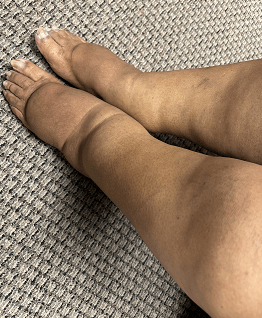
Cardiovascular and Respiratory Examination: No murmurs, gallops, or respiratory distress Clear lung fields bilaterally
Doppler Ultrasound of Lower Extremities: Rule out deep vein thrombosis (negative findings)
Lymphoscintigraphy: Confirm the diagnosis of lymphedema by demonstrating impaired lymphatic drainage in the lower extremities
Diagnosis:
Stage III Lower extremity lymphedema, possibly secondary to age-related changes or an underlying, yet-to-be-determined cause.
LYMPHEDEMA
The abnormal buildup of interstitial fluid and fibro adipose tissues brought on by congenital infection, congenital abnormalities, or injury of the lymphatic system is known as lymphedema. Although it can occur anywhere on the body, lymphedema most commonly affects the extremities. A variety of hereditary syndromes and disorders can cause a defect in the conduits that carry lymph, which leads to primary lymphedema. Acquired disorders can cause a defect or obstruction in lymph-carrying conduits, which can lead to secondary lymphedema.
The patient’s medical history may disclose factors that contributed to the development of lymphedema. Primary causes include genetic syndromes such as Milroy disease caused by vascular endothelial growth factor receptor (VEGFR-3 mutation), lymphedema-distichiasis syndrome (FOXC2 mutation), and hypotrichosis-lymphedema-telangiectasia syndrome (SOX 18 mutation). Primary causes may also include functional causes such as valvular insufficiency or paralysis. The most common secondary cause includes filariasis which is a zoonotic infection caused by parasitic nematodes (due to Wuchereria bancrofti). Malignancy and malignancy-related treatments such as neoplastic destruction of the lymph vessels or surgical removal of lymph nodes are the second most common secondary cause. Burns, recurrent bacterial infections, and wounds to extremities can cause disruption or damage to lymphatic channels. Chronic venous insufficiency and occlusive peripheral arterial disease are also common causes of lymphedema.
The thoracic duct is the main conduit that connects the lymphatic vasculature, a low-pressure system, to the central circulation. The larger conduits in the system contain contractile smooth muscle. The lymphatic vasculature connects interstitial spaces with lymphoid organs like the spleen and lymph nodes. Lymphedema is the characteristic swelling (usually in the extremities) caused by the accumulation of excess water, plasma proteins, parenchymal/stromal cell products, and extravascular blood cells in the extracellular space when there is an imbalance between the rate of lymph production and its removal through the lymphatic vascular channels. Lymphedema happens because of a low-output failure that results in a reduction in lymphatic transport. Progressive fibrosis, cutaneous thickening, hypercellularity, and a pathologic rise in subcutaneous and subfascial adipose tissue can all result from lymphedema over time.
Diagnosis is normally made by clinical history and physical examination. Patients may be asymptomatic or symptomatic depending on the stage with symptoms of impaired mobility of the affected limb or discomfort. Patients with lower extremity lymphedema initially present with unilateral swelling in the dorsal aspect of the foot and after a year it may progress to the proximal aspect of the foot. The edema may spread circumferentially over time. Later on in the disease, nonpitting edema will occur following fibrotic changes in subcutaneous tissue. The skin may be hyperpigmented with increased skin turgor and hyperkeratotic. Physical examination of the skin and extremities will reveal edema which is usually pitting in the early stages but may become non pitting in later stages and be linked to fibrotic changes and the build-up of adipose tissue. The skin should be checked for any complications such as cellulitis. A complete metabolic profile may be ordered to rule out alternative causes of edema such as renal failure. Lymphoscintigraphy may be indicated for cases where the diagnosis is in question. Differential Diagnosis includes edema from a systemic origin such as heart failure, deep vein thrombosis, medication-induced edema, or obesity.
International Society of Lymphology (ISL) staging of lymphedema:
Stage 0 or Ia: Asymptomatic.
Stage I: Edema is present and limb elevation can reduce the edema.
Stage II: Swelling, pitting edema, progresses to nonpitting edema. Elevation does not reduce swelling.
Stage III: Lymphostatic elephantiasis, fibrotic changes, deposition of fat, nonpitting edema.
Complex decongestive physiotherapy (CDPT) also known as Combined Physical Therapy (CPT) should be offered for the management of lymphedema. The goal of CDPT is to reduce limb volume and to support the skin’s health. There are 2 phases to CDPT. Phase 1 involves manual lymphatic drainage, compression, multilayered bandage wrapping, and range-of-motion exercises. Phase 2 includes using fitted clothes to stop the fluid from re-acclimating, remedial exercise, and as many light messages as necessary. Diuretics are normally not indicated for treatment unless there are specific comorbidities that require diuretic therapy. If obesity is a factor, exercise and weight management should be implemented. Surgery can be considered if patients are unresponsive to other therapies and if lymphedema impairs quality of life and function. Unfortunately, despite conservative measures, lower extremity lymphedema frequently worsens. Due to the time commitment, ongoing treatment requirements for the rest of one’s life, the scarcity of certified lymphedema therapists, the cost, insurance coverage concerns, and the discomfort caused by wearing bulky compression garments in hot weather, patient compliance can be challenging.
Author: Farhat Soluade
References:
Van Zanten M, Mansour S, Ostergaard P, et al. Milroy Disease. 2006 Apr 27 [Updated 2021 Feb 18]. In: Adam MP, Feldman J, Mirzaa GM, et al., editors. GeneReviews® [Internet]. Seattle (WA): University of Washington, Seattle; 1993-2024. Available from: https://www.ncbi.nlm.nih.gov/books/NBK1239/
Shikino K, Ikusaka MPrimary lymphoedemaCase Reports 2018;2018:bcr-2018-225843.
“Lower Extremity Lymphedema.” Shibboleth Authentication Request, 23 Oct. 2023, www-uptodate-com.westcoastuniversity.idm.oclc.org/contents/lower-extremity-lymphedema?search=lymphedema&usage_type=default&source=search_result&selectedTitle=2~150&display_rank=2#H1086113072.
DynaMed. Lymphedema – Approach to the Patient. EBSCO Information Services. Accessed January 30, 2024. https://www.dynamed.com/approach-to/lymphedema-approach-to-the-patient

 GlobeMedic