
The Right Ventricular Branch: An Exception to the Rule!

By Dr. Salman Arain
Lately we have had several complex (and complicated) RCA interventions. In such cases we usually don’t worry about the RV branch – if it arises from a diseased segment we protect it, if it away we let it be. Also, the transient loss of an RVB is mostly (but not always) well tolerated. Here is a case that is the ‘exception to the rule’.
Introduction: 75 year old man with known CAD. History of RCA PCI (two?) years ago complicated by perforation and placement of a PTFE covered stent. The patient returns with progressive angina.

Interestingly there is severe ISR within the covered stent – which may explain the rather late presentation. Typical ISR presents within 6 to 12 months.

Our plan was to perform PTCA, hopefully provisionally but you can see the difficulty we had advancing even short balloons. We resolved the support issue with a buddy wire and a guide extender.

There was recoil and we decided to stent with an Orsiro (sirolimus based) stent but we had difficulty in advancing it. The RAO reveals why – a ledge of calcium in the mid RCA! We took care of it with lithotripsy (Shockwave).
Shortly after 10 placement, the patient started to complain of chest pain. He also had diffuse ST depression. We repeated the angiogram, but the flow looked good.

We admitted him to the CCU where he had a modest increase in his cardiac enzymes. The high sensitivity troponin went as high as 18,000(!). The levels started to come down on day 2.

The patient continued to complain of exertional jaw pain on day 3. We maximized his antianginals as much as a blood pressure allow, but he continued to be symptomatic. The echo showed normal LV function.

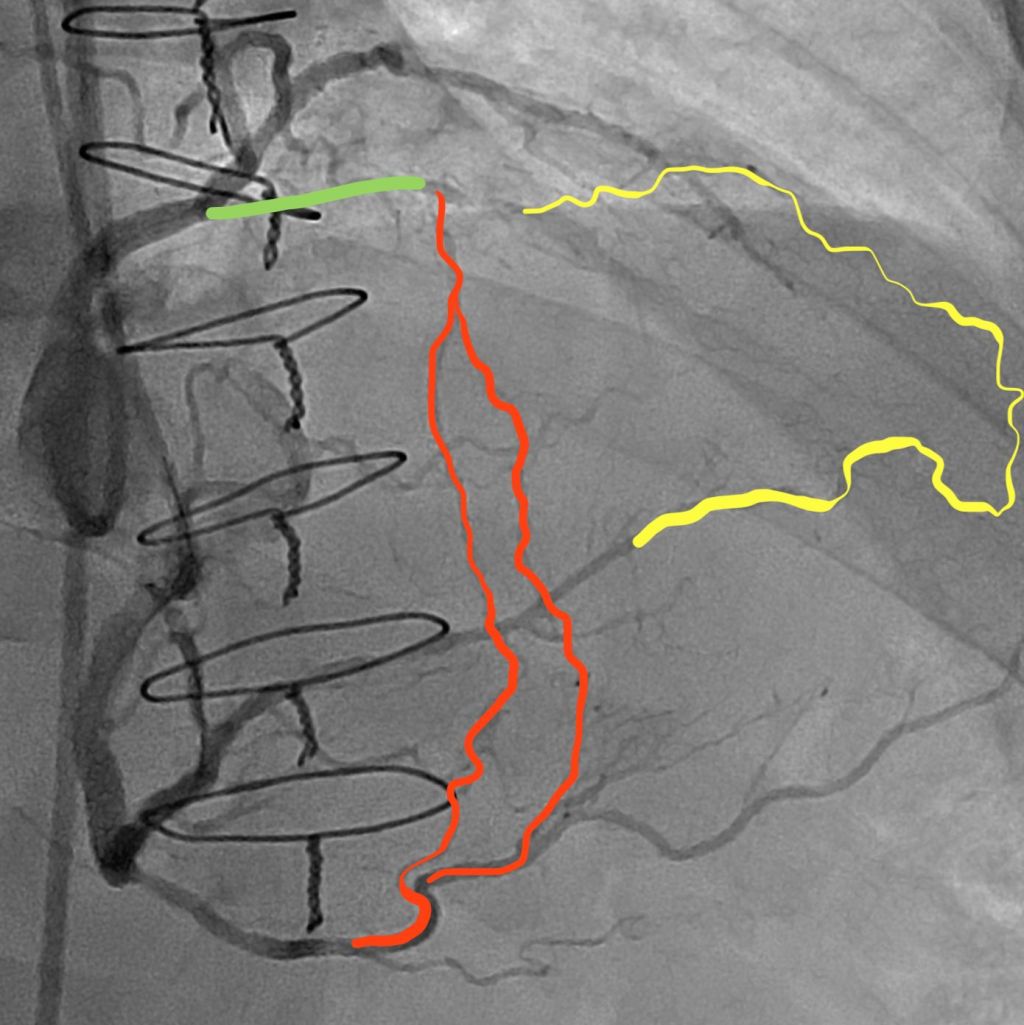
We took the patient back to the lab and found that his RCA was still patent. There is TIMI-2 flow possibly due to the recent PCI and large vessel diameter. However, we can see that there is a small RV branch that had a) disappeared during the first procedure and b) is trying to come back. We decided to open “”rescue it”.

However, this is where things became ‘interesting’. We had considerable difficulty engaging the jailed RVB ostium with multiple wires (both with and without a microcatheter). You can see the challenges here, which include lack of support and a predisposition for wire prolapse.
Some additional thoughts:
1) We took a picture of the left system and it was unchnaged from 3 days ago

2) There were several challenges in wiring: the ostium was jailed, embedded in disrupted calcium, retroflexed or at least perpendicular to the MB, and a relatively wide RCA lumen.
I tried multiple polymer jacketed (slippery) wires to no effect. I even tried a Fighter (0.008 tip) from Boston because it has a non-jacketed tip. For a different grip. But it did not work. With the blocking balloon technique, the wires just kept curling up in the RCA. Also, having a new stent struts did not help – too much exposed metal.
Case Resolution: The Micro JR4!
We decided to try a SuperCross 90 (angle tipped catheter). I gave it a small secondary bend to create a micro JR4, and to our pleasant surprise, it was able to engage the RVB ostium!

Here you can see the micro JR4 in action! We used an anchor balloon to drive the TP LP across the ostium, thus dilating it.

This then allowed us to insert a 1.5 and then a 2 mm ballon. The final angio shows brisk antegrade flow in the recovered RVB.
The patient’s angina resolved completely after the procedure. He felt great and wanted to go home the same day, but we kept him overnight just in case.

An interesting observation: The collateral from the LAD is what kept the distribution of the RVB alive. That is why he continued to have angina, even after the enzymes plateaued. I think it took a day for this collateral to plump up, which is why he suffered immediately after the branch went down.

THE END
What a nice case 👏👏 , masterfully done Salman bhai.
questions
1- would atherectomy have had a lower chance of shutting down side branch compared to lithotripsy
2- did you KISS or POT the RCA after this final ballooning or not needed ?

1) Possibly. Had we used atherectomy, we may have had less disruption at the RV ostium, and we would have cleaved the calcific plaque.

2) I don’t think we did. (Someone else asked and I said yes, but when I checked I couldn’t find the clip).

The goal of the SB balloon was to open the ostium and stretch the struts. Hopefully, the perpendicular takeoff minimized carina shift into the RCA proper.
Great questions Waleed Kayani Bhai. Sometimes we do things “in the heat of the moment” but looking at the case again (alone and with colleagues (like the Houston Cardios!) opens up other possibilities. 😀
A Diagnostic and Therapeutic Challenge

By Dr. Salman Arain MD

Here is a case I recently presented at CVI. I broke it up into different videos for teaching. A PDF of the complete presentation is included at the end.

62 year old man with HTN, DM2, and CKD 3. Presents with progressive angina for three months. Now CCS class 3. The referring MD sent him for a CTA – no stress test available. How would you approach this?

There are several notable features:

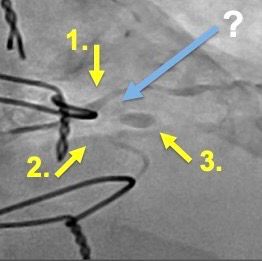
  1. Anonymous left main from the non-coronary cusp.
  2. Proximal LAD occlusion with a diseased mid segment.
  3. Bifurcation disease involving the high ramus/OM1.
  4. Patent LIMA, which supplies the distal LAD.
    4b. Patent intracostal branch from the LIMA, which may be causing a steel phenomenon.
  5. Moderate disease involving the takeoff of the high PDA.
  6. Occluded SVG to the PDA (not shown).

As such, it is difficult to determine the exact location of the ischemia. There is also a second diagonal branch, which is diffusely diseased and supplied by epicardial collaterals.

I asked the referring MD to get a stress test. The patient had ischemia in the basal and mid anterior wall and anterolateral segments.
Our plan was to treat the high Ramus/OM1 and then proceed with the LAD CTO PCI. Here is the LCX PCI. We performed Culotte.

This is the dual injection angio for CTO PCI planning.

Here are some potential options for the CTO PCI.
Antegrade contrast modulation seemed to be our best bet. Here is the sequence for this rather novel crossing technique…

Proximal cap puncture with Gaia 2

The modified Carlino injection. Note the three breakout stains. In chronological order, these are a diagonal, a septal, and the distal true lumen.

These are the three stains. Carlino has a name for this mechanism of CTO crossing. He calls it hydrodynamic contrast recanalization. Or HDR for short. This is a new term that you will be hearing about quite a bit in the future.

It can be difficult to tell if the ongoing stain is re-entry or infiltration into the extra plaque space. A retrograde injection clarifies this.

A Fielder XT without a tip bend is advanced across the channel made by the contrast under fluoroscopic guidance.

The micro catheter is an advanced over this wire. We confirm distal re-entry by means of pressure transduction and…

A distal tip injection.

Here is the final angiogram. This case highlights a new CTO crossing technique introduced by Mauro Carlino, and refined by us at UT. He calls it HDR as noted above. We have just submitted a paper describing the technique, and hopefully it will be accepted (soon!).


For our colleagues: CTO PCI is a mature field and several strategies for crossing CTOs have been developed. Most of them use wires. This ‘new’ technique is not so new – it is modification of an older technique which uses contrast injections. It is called Carlino after the interventionalist who described it.


Career Choices for Trained Physicians: Cardiology

Michael Walter | July 12, 2024 |

Compensation keeps climbing in cardiology, electrophysiology, heart surgery

Cardiology salaries have continued to climb in 2024, according to a new survey from the American Medical Group Association (AMGA). Among general cardiologists, for example, median compensation jumped nearly 8% from $552,000 in 2023 to $596,000 in 2024.

The 2024 AMGA Medical Group Compensation and Productivity Survey includes feedback from more than 189,000 healthcare providers representing nearly 200 different specialties. In 2024, compensation for primary care providers increased 3.6% compared to 2023. Medical and surgical specialties saw compensation go up 5.1% and 5.5%, respectively, and the year-over-year increase for radiology, anesthesiology and pathology was 5.8%.

“We are seeing significant productivity increases, which, in essence, drove the compensation increases across specialties,” AMGA Consulting President Fred Horton, MHA, said in a statement.

A closer look at cardiology salaries in 2024

Diving back into cardiology, most subspecialties saw considerable growth in compensation from 2023 to 2024. Echocardiography lab and nuclear cardiology (12.4%), cardiothoracic surgery (11.2%), cardiovascular surgery (10.5%), interventional cardiology (9.7%), electrophysiology (8.2%), general cardiology (7.9%) and pediatric/adolescent cardiology (5.7%) all experienced healthy year-over-year increases, outpacing primary care providers by a significant margin.

Compensation for advanced heart failure and transplant cardiologists also increased in 2024, but only by 2.9%. Cardiothoracic surgeons focused on pediatric patients, meanwhile, saw their median compensation decrease 2%; it went from $899,000 in 2023 to $881,000 in 2024.

Out of all of cardiology’s subspecialties, the highest 2024 salary belongs to cardiovascular surgeons ($911,000). The lowest, on the other hand, belongs to pediatric/adolescent cardiologists ($356,000).

Changes in work RVUs in cardiology

The AMGA survey also explored work relative value units (RVUs), which went up in 2024 for every cardiology subspecialty. Among general cardiologists, for example, median work RVUs increased from 8,368 in 2023 to 9.010 in 2024, a difference of 7.7%. This resulted in a compensation/work RVU ratio of 2.9% for general cardiology.

Echocardiography lab and nuclear cardiology saw a large year-over-year jump in work RVUs (15.2%), explaining that group’s notable salary bump during the same time period. Even with the higher salaries in mind, however, the compensation/work RVU ratio for that group was -3.2%.

On the other hand, advanced heart failure and transplant cardiologists saw an even bigger increase in work RVUs (18.9%), but that was not associated in any way with higher salaries. This resulted in a compensation/work RVU ratio of -16.4%.

The smallest increase in work RVUs was seen in the pediatric/adolescent cardiologist group; they went up just 0.5% year over year.

Many salary figures listed above were rounded for the sake of simplicity.

Career Choices for Trained Physicians in USA. Viewpoints 1

By Amin H. Karim MD

PREFACE:
In many physician professional social media groups, physicians nearing the end of their residency or into early practice often ask senior physicians in the group about their experience in choosing their career; why did they choose private practice v/s joining a large hospital system v/e faculty teaching or research position? Many senior physicians volunteer the answer to the best of their ability and explain their choices. Some members get to read them and most miss it since the groups like WhatsApp have disappearing messages option and the views of the senior physicians are lost forever. Residents outside the groups never get the benefit of the views and this valuable ad hoc proctorship. The same happens with email and FaceBook groups.

In this section of the website, I have tried to record the views of the volunteering senior physicians and surgeons who have been kind enough to allow us to publish their views. We will do this in an orderly fashion first outlining what specialties are covered (the ones most practiced by Pakistani Descent physicians in USA and Canada) and also try to classify the various avenues of career available to the newly trained doctors at this time i.e. 2024-25 and beyond. We will try to keep the comments updated; readers are also invited to post their own comments in the comments section.

COMMON SPECIALITIES IN USA.
These 30 or so medical specialties are the ones mostly chosen by residents from Pakistan. There are many other subspecialties within these groups, which are beyond our scope for now.


These are alphabetically arranged.
Addiction Medicine
Anesthesiology
Colon and Rectal Surgery
Cardiovascular Diseases General.
Cardiovascular Disease Interventional
Critical Care Medicine
Dermatology
Endocrinology
Emergency Medicine
Family Medicine
Gastroenterology
General Surgery
Geriatric Medicine
Hematology
Hospitalist
Infectious Diseases
Internal Medicine (General In and Outpatient)
Nephrology
Neurology
Neurosurgery
Oncology
Orthopedic Surgery
Otolaryngology
Pain Management
Pathology
Pediatrics (General)
Physical Medicine and Rehabilitation
Plastic Surgery
Psychiatry
Pulmonary Diseases
Radiation Oncology
Radiology
Rheumatology
Urology
Wellness Medicine
OTHER (Please define in your comments)

CAREER PATHS AVAILABLE TO TRAIND DOCTORS AS OF 2024:

Private Practice Solo
Private Practice with Uni Specialty Group Self Managed
Private Practice with Uni Specialty Group Managed by a Company
Private Practice with Multispecialty Group Self Managed
Private Practice with Multispecialty Group Managed by a Company
Health Care Administration
Hospital Employment
Academic Employment with a Teaching Institution
Pharmacological Company Employment.
Veterans Administration Employment
Government/Armed Forces
Government/Federal/
State/County/City Employment.
Other (please define in you comments)

PROCTORING COMMENTS FROM PRACTICING AND/OR RETIRED PHYSICIANS
Here are the comments in the order received: For volunteering proctors please use the set up as below and send it to me

AMIN H. KARIM MD
CARDIOVASCULAR DISEASES INTERVENTIONAL
PRIVATE PRACTICE SOLO
I have been in Solo private practice of Cardiology since the late 1980s.
I started immediately after graduation from the fellowship program and have lived and practiced in Houston, Texas since then. Will not go into details of how we did in those years in the last century (although you can read about them on this website under My Journey. The object is to guide the younger generation onwards since the medical world has changed and is fast changing.
I will simply list the PROS AND CONS.

PROS:
1) Number one is INDEPENDENCE. You are your own boss and everyone knows what that means. The buck stops on your desk bringing its own responsibilities.
2) Brings forth all your innate faculties, innovation and resources to learn, plan, implement and see the results. Rejoice in the success and learn from failures!
3) Put your best effort and hard work with resulting satisfaction. This includes marketing, accounting, purchasing and other nitty gritty of running a business.
4) Bring forth your best in manners and behavior towards everyone including patients, employees, referral physicians, colleagues and even relatives. Each one of them are important in the success of your practice in sending referrals and in their comments to others.
5) Last but not the least, the satisfaction of knowing that what you are making is yours and the patients you are making and the name you are making in the community are your “equity” that is only going to build with time. Also you get to claim many expenses in your returns and have your own 401K retirement plan for retirement.

CONS:
As they say there are no free lunches.
1) Number one expressed by many is more time to the practice and less for family. Here you need to plan and adjust according to your needs as time goes.
2) Hassles of billing, insurance, employee retention, regulations like OSHA and HIPPA, Metric s reporting. These have solutions these days as there are companies for everything. Billing and Payroll should always be outsourced as it is not worth doing it yourself. Virtual receptionists are available and your secretary (costing much lower) will be in Pakistan or Philippines.
3) But at this stage, it is becoming increasingly difficult to establish as solo in large cities, unless you are giving an income guarantee (still legal) in outlying area by a new hospital or are willing to go to an area lacking your specialty and still live nearer to the city (eg living in Houston and practicing in Angleton or Baytown).
For the brave and adventurist nothing is impossible. It can still be done for the one who is willing to put in long hours in the beginning.

MUNIR A. SHIKAR MD
Cardiovascular Diseases General
Solo Private Practice
It’s good option if you are young – it takes a lot of time and a lot to learn with a learning curve. Once you are set it’s great. Soon you can pick juniors and make sure you know to reap the harvest of the basic set up that you do. Make sure that you always have an edge above others in any contracts that you make for or with others
Step ladder – solo and soon in couple of years at best partners of single specialty and merge a few years later with larger group with multispecialty group
Pick a specialty of your choice with office and hospital procedures coz that’s the beef of practice
Member: APCNA

ANONYMOUS
Pain Management
Solo Private Practice
I have been in the practice of Pain Management for last decade. It’s non-interventional and includes Addiction Medicine.
Pros: There is a lot of satisfaction in treating pain, even if by a simple trigger point or joint injection. Even removal of joint fluid can add to the comfort and mobility.
Cons: Patient’s tend to be difficult, especially if they have been addicted to narcotic pain medicines or years. Taking them off these can be a challenge.
Then there are professional pain medicine traders who bring in people to make up a story and get a prescription for pain meds. Regulators always watch closely.
Member: APPNA.

ANONYMOUS
Colon and Rectal Surgery
Multispeciality Group Self Managed
Very satisfying and you can do some good for patients. Patients are quite miserable with colorectal problems and they are usually appreciative.
PROS: Good lifestyle, you can work as little or as much as you want. You can do minor surgeries or very major surgeries.
CONS: I cannot think of any. But some people don’t like to deal with poop.
Would choose same again
Member of APPNA.

ABDUL MUNIS
Internal Medicine
Private Practice in Uni Speciality Group Self Managed.
Worked 20 years as hospitalist now working in post acute care for last 4 years
Pros: Less stress time flexibility more time off reasonable income
Chronic pts in nursing home poor nursing family pressure
Would choose a SPECIALTY if given a chance to start all over
Do you what likes you best adjusting for your life style

If you wish to give your views, please click on the link below to go the Google Forms and fill it out. If accepted, we will add to the above

https://forms.gle/b6NLpbUY478vbrAC6