STEMI on the Forehead !

Amin H. Karim MD
Institute for Academic Medicine
Houston, Texas

Today a 65 year old patient showed up in the office. He had not seen me for last 5 years for whatever reason and now needed a surgical clearance. He worked as a RN at a Houston Hospital and subsequently at the VA Hospital;

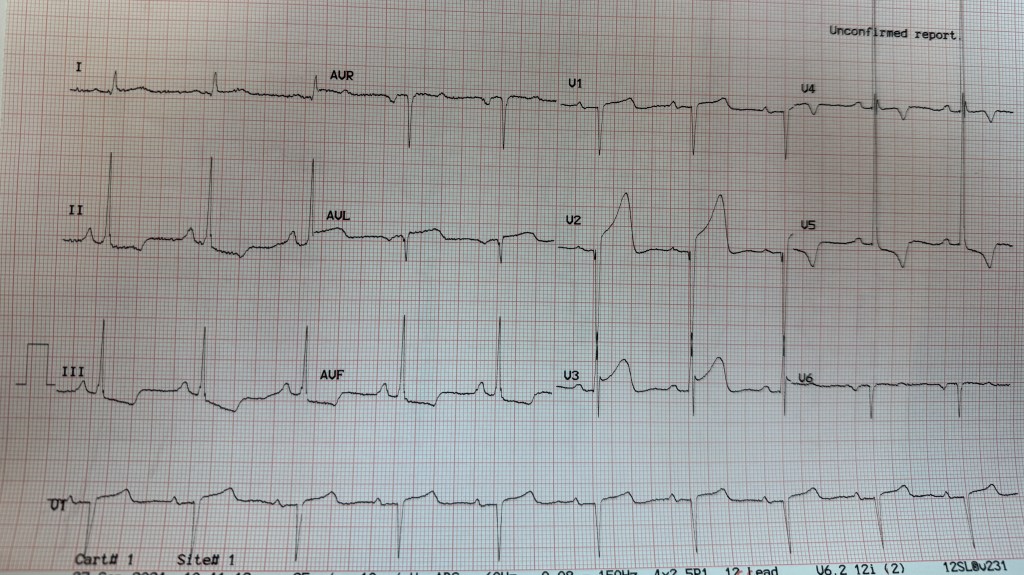
I did a routine EKG as follows:

It was unchanged from his previous EKGs from years ago. When he was following with me, he had a cardiac workup including imaging tests showing normal coronaries.

On taking his interval history, I found some interesting facts. While working at the VA he had some atypical chest pain. He went to the ER and had an EKG and was seen by a cardiologist stat. He was rushed to the catheterization lab and had a diagnostic cardiac catheterization which showed normal coronaries. A few months later he had similar chest pain and again went to the ER at a premier hospital in town for evaluation. An EKG was done and STEMI was called immediately. He protested to the cardiologist that he had cardiac catheterization a few months ago and that it was normal! The cardiologist was insistent that he have another one since his EKG showed that he was having a heart attack and could die. His protests were to no avail and he was rushed to the lab and had another diagnostic cardiac study which of course showed normal coronaries. The cardiologist came and apologised to him for not listening to him.

Now it was my turn to beat him on the head and tell him: ” You have STEMI written on your forehead. Wherever, you go you will be treated with emergency response and the STEMI will be summoned and you will be rushed in an elevator with a security guard holding it! Once in the cath lab you will be surrounded by a frantic team counting minutes!

So this is what you are going to do. You will take a copy of your EKG, go to Office Depot and have it reduced and laminated; then carry it with you in your wallet and if you land in the ER and before they wheel you away to the cath lab, show them the EKG and tell them that your EKG is always abnormal and that they should compare to see if there are any changes. Otherwise you will someday end up with a clot in your hand or leg or some other complication!

I think he got the message.

No offence meant and take it in the lighter vein, but I am sure every interventional cardiologist taking emergency calls faces these alarms and the 90 minutes door to balloon time does not allow much margin to hunt for old EKGs!

Amin H. Karim MD
September 27 2024

Foot in the Door: A Complicated RCA!

By Salman Arain MD

Case of the Week – A Foot In The Door May Be All You Need!

Here is a complicated RCA intervention from this week with several discussion points. There is a bonus here – my technique for changing guides over a coronary wire. There are several sequences – but not as many as there could have been!

Baseline angio. 73 year old woman with severe angina – history of bypass with failed RCA graft. Has critical ISR at the RCA ostium. The referring had difficulty stabilizing a JR4 guide and was unable to wire the stenosis.

Here the initial wiring sequence. We used an AL1 to engage the ostium as best as we could. We used a Fielder XT to wire the ISR – it is the perfect wire to do this because of the tapered tip, the polymer jacket and the supportive shaft.

But that AL1 position is not ideal for working. The next is to build up support. We used a TurnPike LP to dilate the channel and switch out for an exchange length wiggle wire. TP LP is ideal because of its double nitinol braid – it can drive itself forward even when support is suboptimal. Once the wire is in, we can dilate with a long balloon. IVUS to follow.

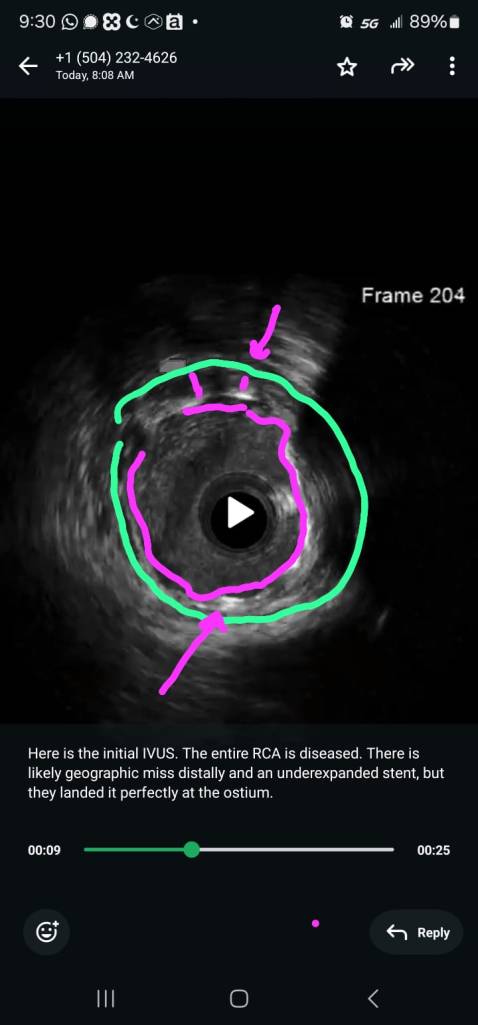
Here is the initial IVUS. The entire RCA is diseased. There is likely geographic miss distally and an underexpanded stent, but they landed it perfectly at the ostium. An AL1 is not the best guide for the remaining sequence which involves engaging and disengaging the RCA ostium. So we decided to switch guides.

Here the entire sequence to switch the guides over a coronary wire. You need a long (preferably supportive) coronary wire, and exchange length 0.035 wire, and patience!!! The 0.035 wire straightens out the AL1 during transfer.

Here is the post IVL result by IVUS. The calcium ring is disrupted is several places!

After using a 4 mm NC balloon, we implanted a 4 x 48 mm SYNERGY. Here is the post stent IVUS. We post dilated with a 4 mm NC balloon.

Here is the final result! You can see the contrast in size between the stented segment and the native, diseased RCA. There is always a risk of ‘over stretching’ the vessel when IVUS measurements are strictly followed, but this is an acceptable ’step down’.

QUESTIONS:
AA Salman bhai, I had 3 questions for my own learning, not questioning. Angiographically its a beautiful result as expected from you.

is the stent truly undersized or just underexpanded (heavy calcium) in some areas by the original operator?

any for shockwave or laser (not great for calcium ) to help expand the calcium. on your post ivus the calcium appears to prevent expansion but angiographically looks awesome. risk (calcium perf ) /reward of expanding this area with a short 4.25 NC given his prior restenosis and ostial location. i would have left it as you did,

why wiggle wire? what other wire if not wiggle wire?

Good questions.

1) Undersized versus under expanded? Difficult to say. As you know, most stents between 2.5 and 3.5 mm are the same size. The difference is in the size of the balloon that they are mounted on. (@Waqas T. Qureshi MD Bhai can confirm or refute this). So, it is difficult to say whether the stent was just undersized from the get-go or not fully expanded. But it is clear that there is geographic miss and under preparation of the vessel.

2) Absolutely. I highly recommend aggressive post dilation after any atherectomy or IVL. You have to ensure the vessel will expand before the deploying another stent.

2b) This also highlights the limitation of angiography alone to gauge vessel size in diffusely diseased arteries.

2c) Post dilation options include noncompliant balloons and (now) OPN.

3) Any supportive wire may have worked. I like to use the wiggle when dealing with torturous RCAs or LADs. The wiggle portion often locks the wire in position, adding to the support provided by the wire. Of course, any other support wire may have also worked.

The LAD Challenge!

By Dr. Salman Arain MD

Challenge #1. Here is the baseline angio. The challenge here is wiring the mid LAD. The wire tip shape needed to cross it is different than the one needed to reach it. Our solution – a dual lumen catheter (Sasuke) in the mid LAD which allows us to secure the D2.

Challenge #2. We wired the D1 to secure it during provisional LAD stenting. There is plaque shift +/- thrombus which shuts down the D1 by the time we have treated the mid LAD. Luckily we still had the wire in place – so in goes the Sasuke again. We were able to guarantee that the wires did not end up behind the stent struts.

Challenge #3. We did a proximal POT, pulled the jailed wire, and passed it down the LAD. I did not want to keep working on the Fielder. Note the brief detour into D2. Alas, we ended up with a dissection! After this point the patient started vomiting and the ST were really deep. I felt that the 6 Fr guide was workkng against us. As you can see much of the LAD has shut down. Our solution – intubate, insert Impella, upsize to 7 Fr.

Challenge #4. Here is the groin angio through the 14 Fr Impella sheath. The leg will likely become ischemic during the case- so we put in a retrograde SFA sheath for future ‘external bypass’.

Challenge #5. Our first angio after Impella placement shows clot in the entire LAD!!! 😳😩 I called for Penumbra, but decided to make a pass with an Export while the cath lab was setting up. Surprisingly we were able to ‘uncork’ the LAD.

Challenge #6. The next step is to treat the D2 and optimize the mid LAD stent. There is stent recoil. IVUS showed a fibrotic lesion – we treated this with a cutting balloon and completed the LAD PCI. Or did we…

Challenge #7. The completion angio shows thrombus in the proximal LAD – address it with medications or aspirate? We tried PTCA but it embolized. Well, by this time the Penumbra was set up. We were able to complete the procedure (again!). This is the final coronary angio.

Challenge #8 (No more, I promise): How to keep the leg perfused while the Impella was in place? Here is a clip of the initial angio through the Impella sheath. The third clip is through the SFA sheath (using a micropuncture dilator) after the external bypass has been set up (right CFA -> left SFA). I do this to confirm pulsatility in the occluded leg.

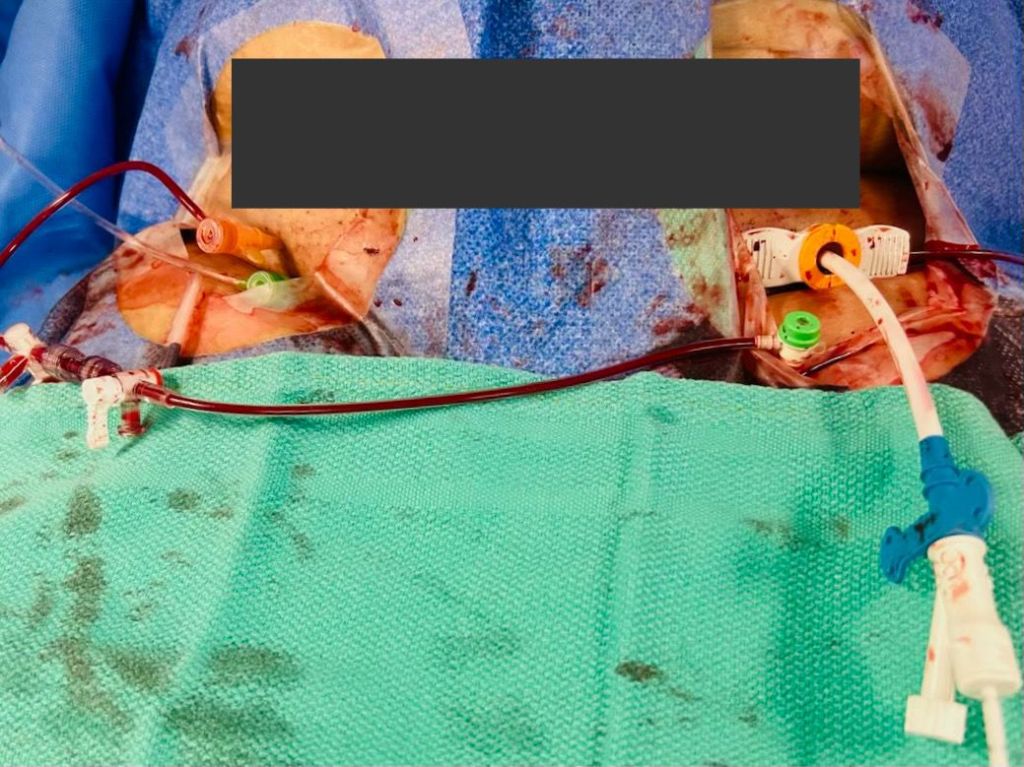
This is what the set up looks like. There are several advantages to doing it this way. The retrograde sheath is easier to insert, doesn’t compromise antegrade flow to the leg, allows you to do an angio to confirm Impella sheath closure (if done), perform internal balloon tamponade on the proximal arteriotomy (if needed) and importantly – makes sure there is no dead zone in the CFA. As a bonus, you can close this with an AngioSeal later if needed.

The End.
Question: How would you take out the antegrade sheath? Manual and balloon tamponade the CFA from contralateral?
Answer: They are both retrograde. The angio shows it. It looks antegrade because of the body habitus.
The typical sequence is:
1) Remove Impella
2) Exchange Impella sheath for new sheath without flushing
3) You may do an angio from the lower (SFA) sheath at this stage. This is optional.
4) Treat the proximal arteriotomy with Manta or double Perclose.
5) Confirm closure with injection through the lower sheath.
5a) Consider balloon tamponade from the lower sheath if needed.
6) Close the lower arteriotomy if the SFA is ‘clean’ – you must use a device. It is too deep for manual hemostasis.
7) Confirm close from the contralateral side.

1) These are recommendations for Impella inserted in an emergency – and expected to stay in for some time. Usually there is no time for Preclose if the patient is crashing.
2) Also, I don’t Preclose unless I know the Impella is coming out within 6-12 hours.
2b) We have left the sutures in longer but management becomes an issue if the CCU stay is prolonged.
3) You don’t have to put a new Impella sheath in. Any 14 Fr sheath will do.
4) The idea is that there may be thrombus in the old sheath – in the space between the sheath and the Impella.
4b) Of course, you can hook it up to pressure to keep it open – but we have had thrombus form despite that too.
5) When the Impella comes out, you can use your favorite method to obtain hemostasis. Double Perclose is just one.
6) Stick the SFA in the cleanest part – avoid being too close to the Impella sheath. You don’t want the lower sheath tip ‘tucked under’ the Impella sheath.

We have left Impellas in upto 5 days with good leg perfusion using this method. The best part is that you can take it out yourself in the cath lab. No need for the OR.
Question: SA; trying to understand..
The need for# 6? Why is the SFA stick needed?
This is required when the Impella sheath is occlusive in the iliacs or the CFA. In such cases the leg with the Impella becomes ischemic.

One way to prevent this is to gain antegrade access into the CFA or SFA and create an ‘external bypass’. Usually this is done with US guidance and is a little tricky.

Our method makes it wasy because you can stick the SFA without changing the side you are standing on. Also, if you use a roadmap (like we did) you can do it without US. Because there is usually some flow via the profunda: CIA -> IIA -> PFA -> CFA/SFA.

Question: Also, for the SFA are you using an Arrow sheath ?
Answer: Yes, always an Arrow sheath. Given the depth of the vessel and the angles involved, you need a braided sheath. Non-braided sheaths will typically soften and kink.

Treating a Common disease in an Uncommon Country: Hepatitis A

By Syed Aman Ali
Medical Student, Jinnah Sindh Medical University, Karachi. Pakistan
Amin H. Karim MD
, Houston, Texas

A condition that, once diagnosed in a young person, can be treated conservatively with diet and rest, can end up being treated expensively in a milieu where defensive medicine and financial incentive join together.
The case below is an example.

Case Presentation

A 20-year-old male student presented to the clinic with a 1-week history of abdominal pain and jaundice. He described the abdominal pain as a heaviness localized to the upper right quadrant, rating it 8 out of 10 on the pain scale. The patient also experienced mild fever, vomiting, and a headache. Patient later noticed jaundice, evidenced by icteric eyes and yellowing of the skin. He also reported dark urine and pale stools. He had recently traveled from Pakistan to the United States and went on a cruise approximately 2 weeks prior to the onset of symptoms.

On physical examination, the patient appeared generally well but jaundiced. Examination of the abdomen revealed tenderness in the upper right quadrant but no guarding and an enlarged liver. Patient was  advised bed rest and symptomatic treatment till he felt better and was sent home. 

Lab results were returned they showed that Hep A antibody was found to be reactive while Hep B and Hep C were non- reactive.  Patient had a high total bilirubin of 12.8 mg/dl and alkaline phosphatase was raised to 182 U/L. AST was raised to 4317 U/L and ALT was raised to 5340 U/L. Patient had an increased hemoglobin 17.8g/dl and hematocrit 55.9%. The plan from our end continued to be conservative and symptomatic.
At the insistence of parents, patient saw a gastroenterologist for a second opinion and was immediately sent to the emergency room where he was admitted to the hospital for three days. A second gastroenterologist was called upon to see the patient. All of the lab reports were repeated and more tests were done including Epstein Barr virus test, cytomegalovirus test, thyroid panel. Patient had an ultrasound of the abdomen showing normal results an abdominal CAT scan showing normal result to be followed by an MRI of the abdomen which was also normal. The rationale for doing all three tests with a low pre-test probability of finding anything of significance was not known, Liver function tests were repeated on a daily basis. Liver biopsy was contemplated but not done. Family was reassured by providers that all is being done to make sure the condition does not become worse and that no “other conditions” are being missed!

In summary, the overall cost for the patient’s treatment, considering all expenses, ranged from $20,000 to $24,000. This cost reflects the comprehensive management of a benign condition easily treated with supportive care.

Discussion

Hepatitis A is an acute viral infection caused by the Hepatitis A virus (HAV), transmitted primarily through contaminated food or water. This positive-sense, single-stranded RNA virus, belonging to the Picornaviridae family, primarily affects the liver. It is a significant global health issue, especially in areas with poor sanitation. Typical symptoms include jaundice, fever, abdominal pain, and fatigue. While often self-limiting, Hepatitis A can lead to serious complications in some cases.

Complications and Variants

  1. Cholestatic Hepatitis A: Characterized by prolonged jaundice and impaired bile excretion, leading to darker urine and pale stools. Recovery is often longer and more intense.
  2. Prolonged Hepatitis A: Symptoms such as fatigue and jaundice extend beyond the usual acute phase, requiring extended care.
  3. Relapsing Hepatitis A: Involves periods of improvement followed by recurring symptoms like jaundice and abdominal pain, complicating the clinical course.

The chances of the above complications not withstanding, the condition in young people is benign and self limiting with no sequalae, in fact long term resistance to repeat infection

An important factor is to enhance the protocols for diagnosis and therapy. Better resource management and lower total costs can be achieved by establishing standardized care standards that prioritize evidence-based, economical therapies and simplify diagnostic tests to prevent redundancy. Improving the infrastructure for healthcare is also essential. By investing in sanitation and hygiene improvements in high-risk areas, as well as expanding access to early treatment and preventive care through community health centers and mobile clinics, outbreaks can be avoided and the financial strain on the healthcare system can be minimized.

Lastly, encouraging innovation and research can lead to advancements in prevention and treatment. Encouraging research into new, cost-effective management strategies and adopting best practices based on research findings will contribute to better healthcare outcomes. By implementing these strategies into practice, we can improve patient care while lowering costs in a more effective and efficient healthcare system.

Conclusion 

In conclusion, this case study reveals a significant and somewhat ironic truth: treating Hepatitis A, a condition that often resolves on its own with minimal intervention, can still come with a hefty price tag of $20,000 to $24,000 in a milieu of defensive cum financially incentivized medical care. To address this, we should focus on preventive measures like vaccination and improved sanitation, which can help reduce both the incidence of Hepatitis A and the associated treatment costs. Additionally, refining diagnostic and treatment practices, investing in better healthcare infrastructure, and encouraging innovation in care strategies can lead to more efficient use of resources and reduced costs. By making these changes, we can enhance patient care and alleviate the financial strain on the healthcare system.