Failure to Treat Hypertension

Close Case Study

Presentation and physician action

A young man came to his internal medicine physician over several years for various symptom-focused visits. On the majority of these visits the patient’s blood pressure readings were elevated. Two months after his last exam, the patient died suddenly at home. He was 31 years of age. The cause of death was determined to be a complete occlusion of the left anterior descending artery (LAD).

Autopsy findings were inconsistent with hypertensive coronary artery disease, as there was no heart enlargement, dilation of the left ventricle, pitting of the kidney surfaces, or dilation of the aorta. The pathologist did not see any evidence of end-stage organ damage caused by untreated hypertension. The pathologist concluded that the cause of death was from atherosclerotic plaque becoming disrupted and traveling to the LAD, causing occlusion and a fatal arrhythmia.

Both the pathologist and consulting cardiologist agreed this heart attack could not have been prevented since the patient did not suffer from hypertension-induced coronary artery disease.

 The defendant, while providing reasonable episodic care, did not address the patient’s elevated blood pressure. The physician says he instructed the patient to watch his diet, but this was not documented in the records. The physician did not order any lab work or evaluations addressing the hypertension.

Allegations

The patient’s family filed a lawsuit against the physician for failure to diagnose and treat hypertension. It was further alleged that the physician failed to order proper evaluations and lab work and failed to provide the patient with precautions and advice on lifestyle changes. The plaintiffs argued that had the physician treated the patient’s hypertension, it would have prevented the sudden heart attack and death.

Legal implications

The patient came to the physician nine times over an 8-year period for various symptoms. During this time the patient never described any chest pain or dyspnea that would have increased the suspicion of heart disease in such a young patient. However, high blood pressure is a risk factor for heart disease, and the patient’s initial blood pressure reading was 164/110 mm Hg. Although the blood pressure read­ings fluctuated, consultants felt the patient had stage 1 hypertension.

Though most consultants agreed stage 1 hypertension does not require immediate medication, they were critical of the physician’s inaction (not taking repeat read­ings, considering family history of hypertension, documenting in the medical chart discussions of hypertension counseling, conducting lab studies for lipid profiles and other tests).

Most defense consultants agreed that it was a judgment call to treat this young man for borderline hypertension, and the lack of hypertension treatment had no bearing on the sudden MI. However, they all stated that the patient should have been more closely monitored with regular blood pressure checks, diagnostic labs, and counseled on modi­fying diet and lifestyle.

Making this case more difficult to defend was the physician’s admission at deposition that he was not clear on the standard of care in treating hypertension.

Disposition

This case was settled on behalf of the internal medicine physician.

Risk management considerations

Incomplete documentation often hinders the defense of lawsuits. Each patient encoun­ter should include the chief complaint, examination findings and prior diagnostic tests results (if applicable), assessment, clinical impression or diagnosis, and the plan of care. Not only did this physician not support his clinical impression of the patient’s blood pres­sure, the only acknowledgement of the blood pressure readings was a circle around the numbers.

Completed histories are the basis for patient information. It is not unusual to have a pa­tient complete a questionnaire before the appointment as this helps expedite the patient visit; however, reviewing the form and completing areas left blank may provide additional insight. By initialing and dating each page, a physician can provide verification that the information was reviewed.

Some consultants believed that, given the patient’s family history of hypertension, medi­cations should have been started immediately. Most consultants agreed that education on dietary and lifestyle changes was more important the first year. Unfortunately, the patient’s chart supported the plaintiffs’ view that the physician failed to advise the patient of his cardiovascular and hypertension risk factors.

Physicians can make themselves more defensible by obtaining a complete his­tory, documenting each patient encounter, and documenting any education provided to the patient. This assists both the patient in making informed choices and the physician, should the patient allege failure to diagnose and treat.

Maintenance of Certification

February 5, 2024

Maintenance of Certification—The Value to Patients and Physicians

Robert O. Roswell, MD1Erica N. Johnson, MD2Rajeev Jain, MD3

JAMA. 2024;331(9):727-728. doi:10.1001/jama.2024.0374

In 1936, the American Medical Association and the American College of Physicians jointly formed the American Board of Internal Medicine (ABIM) as an independent assessment organization to distinguish internists who met peer-reviewed established standards. The mission of the ABIM is to enhance the quality of health care by certifying internists and subspecialists who demonstrate the knowledge, skills, and attitudes essential for excellent patient care.1 For more than half a century, the process of board certification ended at the beginning of a physician’s career with initial certification. In 1990, with the goal to assure the public that certified physicians are maintaining their knowledge and skills, ABIM began requiring periodic reassessment of medical knowledge to maintain certification in all disciplines. Medicine is evolving at a rapid pace, and by participating in maintenance of certification (MOC), physicians can reassure patients, colleagues, and themselves that they are doing what they need to do to stay current in medical knowledge and practice.

At a time when physicians are overwhelmed by bureaucratic requirements of prior authorization, required institutional trainings in everything from workplace safety to billing and coding, and collectively recovering from the massive and ongoing trauma that is COVID-19, some physicians have begun to question the benefits of certification.

ABIM acknowledges the challenges and demands facing today’s practicing physicians and uses diplomate feedback to improve its programs and processes. Based on feedback from the diplomate community, ABIM has launched the Longitudinal Knowledge Assessment (LKA). The LKA was designed to better accommodate physicians’ schedules and desires for flexibility. Approximately 80% of ABIM-certified physicians across all disciplines are choosing the LKA over the traditional long-form MOC examination. The LKA does not require preparation, takes 4 hours per year on average, and, after questions are answered, provides the diplomate with immediate feedback, rationales, and references while offering the opportunity to provide critiques of the item to ABIM. Across all disciplines, 70% of diplomates agree, 16% are neutral, and 14% disagree with the statement that “the LKA is a fair assessment of clinical knowledge in this discipline.”

Importantly, all of these innovations occur with the oversight of a diverse governance structure that includes physicians from a vast array of practice types, and also nonphysician public members. Early in its history—dating back to 1936—ABIM governance was largely drawn from the ranks of the academy and specialty societies. But in 2014, ABIM substantially modified its governance to oversee policy in each of its disciplines and complement the work of committees creating examination content; newly appointed governance members were selected to represent the range of practice types and physician experience within each discipline, along with both patient and nonphysician clinical team members. With the launch of the LKA in 2022, content generation was expanded to more than 1000 volunteers. This expansion intentionally included a majority of practicing physicians from the community who work in a broad range of settings. ABIM aims to be a vehicle through which the profession of internal medicine sets standards for itself.

All physicians engaged in patient care bear the heavy burden of all the cost and work it takes to stay current in the field to provide state-of-the-art evidence-based care to their patients. To help with these challenges, in launching the LKA, ABIM lowered the 10-year cost of the continuing certification program for all physicians—regardless of how many certificates they hold—if they participate in the LKA to maintain them. It now costs $220 per year to maintain 1 certificate and $120 for each additional certificate.2 To ensure financial transparency, audited financial statements including Internal Revenue Service Form 990 are made public by ABIM as soon as they are available, an action that not all nonprofits follow.2 The organization has earned a Platinum Seal of Transparency from Candid for its financial transparency, which includes publicly posting financial statements and a guide on how to read the organization’s posted financial documents.2,3

A large and growing body of evidence from published, peer-reviewed, cohort studies with adjusted statistical analyses has shown that patients who are cared for by physicians who demonstrate more medical knowledge through certification and MOC have a better prognosis for a host of important outcomes including lower mortality from cardiovascular disease, fewer emergency department visits, fewer unplanned hospitalizations, better adherence to medical guidelines, improved results on myriad process-of-care measures such as opioid prescribing and diabetes care, and fewer state medical board disciplinary actions.4

Physicians who were required to complete MOC to stay certified provided 2.5% lower total cost of care to Medicare beneficiaries without any decline in measured quality. This translates into approximately $5 billion per year in health care savings when extrapolated to the entire Medicare population.5 The totality of evidence around certification and MOC now includes studies collectively involving tens of thousands of physicians and hundreds of thousands of patients. Despite limitations in these studies, there are important positive associations on patient outcomes.

Some physicians wonder if self-assessment alone could ensure better outcomes and more efficient care. The president and chief executive officer of the Accreditation Council for Continuing Medical Education recently argued that for CME to be effective in closing identified knowledge gaps, it was necessary to have a continuing certification program using objective assessments of medical knowledge.6

ABIM continually seeks to improve its certification procedures. To ensure fairness and recognition of the structural forces that may bias assessments such as certification questions, ABIM has invested in fairness reviews of questions on several examinations to identify and remove bias if it is found. Health equity was recently approved as a new content area on ABIM assessments. There is ongoing work to enhance the knowledge of extant health disparities on examinations, including best practices in advancing health equity. ABIM meets regularly with specialty society leadership. A future assessment innovation requested by some medical societies will include the introduction of practice profiles in some disciplines where practice data demonstrate concentrations of practice within the discipline; these concentrations will facilitate the design of more tailored assessments that will enhance relevance.

Emerging technologies, like artificial intelligence and large language models, will create innovative assessment approaches, and ABIM has committed to explore them, even as we ensure that demonstration of individual physician knowledge remains the foundation of certification, a process that explicitly and publicly recognizes the skills and expertise of an individual physician.

Prior conversations with physicians have led to significant changes in MOC. With physicians’ input and keeping patients at the forefront, ABIM’s programs will continue to evolve. Physicians earning and maintaining certification should be recognized for their accomplishments in obtaining and keeping their medical knowledge current throughout their careers. We look forward to continuing to engage the community of internists and subspecialists as we also continue to provide a way to recognize the value of the hard-earned expertise board-certified physicians offer to their patients, colleagues, and the medical community.

Back to top

Article Information

Corresponding Author: Robert O. Roswell, MD, Associate Dean for Diversity, Equity, and Inclusion, Departments of Cardiology and Science Education, Donald and Barbara Zucker School of Medicine at Hofstra/Northwell, 2000 Marcus Ave, Ste 300, New Hyde Park, NY 11042-1069 (rroswell@northwell.edu).

Published Online: February 5, 2024. doi:10.1001/jama.2024.0374

Conflict of Interest Disclosures: Drs Roswell, Johnson, and Jain report that they are officers of the ABIM Board of Directors and receive an honorarium for their service.

Additional Contributions: We acknowledge Seth Landefeld, MD, officer, ABIM Board of Directors, for his contributions to this work. No compensation was received.

References

1.

American Board of Internal Medicine. About ABIM. Accessed November 17, 2023. https://www.abim.org/about/mission/

2.

American Board of Internal Medicine. ABIM fees. Accessed November 17, 2023. https://www.abim.org/maintenance-of-certification/policies-fees/

3.

American Board of Internal Medicine. ABIM candid profile. Accessed December 20, 2023. https://www.guidestar.org/profile/39-0866228

4.

American Board of Internal Medicine. Evidence supporting certification and MOC. Accessed November 17, 2023. https://www.abim.org/evidence

5.

Gray  BM, Vandergrift  JL, Johnston  MM,  et al.  Association between imposition of a maintenance of certification requirement and ambulatory care–sensitive hospitalizations and health care costs.   JAMA. 2014;312(22):2348-2357. doi:10.1001/jama.2014.12716
ArticlePubMedGoogle ScholarCrossref

6.

Lyness  JM, McMahon  GT.  The role of specialty certification in career-long competence.   Acad Med. 2023;98(10):1104-1106. doi:10.1097/ACM.0000000000005314PubMedGoogle ScholarCrossref

Death Before Cardiac Cath: Closed Case Study

Illinois cardiologist not held responsible for patient’s death while waiting for angiogram

Dave Fornell | February 21, 2024 | Cardiovascular Business | Legal News

A judge in the Illinois 5th District Court of Appeals upheld a previous trial victory that cleared central Illinois cardiologist Amit Dande, MD, and Prairie Cardiovascular Consults LLP of alleged misdiagnosis of the severity of a patient’s heart condition that led to his death prior to a scheduled angiogram. 

In the opinion issued Feb. 20, Judge Mark Bovard upheld the lower court’s decision in favor of the defendants.

The plaintiff, Cheryl Wilson, brought a wrongful death action claiming her husband Leslie Wilson died as a result of the cardiologist being negligent in his evaluation. The claim alleged Dande did not understand the severity of Wilson’s heart condition and failed to intervene in a timely manner. But the jury in the case decided he was not negligent and followed the normal standard of care for a patient with stable ischemia.

On appeal, the plaintiff claimed that the trial court erred in allowing the defendants’ medical expert to testify about possible causes of the patient’s death. There was debate among the medical experts in the trial because no one knew the actual cause of death, since no autopsy was performed. The plaintiff also said the court refused to admit into evidence Wilson’s complete death certificate with the cause of death, and denied the plaintiff’s motion for a directed verdict on the allegation that the defendants failed to properly instruct the patient to restrict his physical activities while awaiting the heart catheterization procedure.

After reviewing the trial results, Bovard opted to let the lower court decision stand.

Details from the malpractice trial

On July 29, 2015, Dande met with the patient, reviewed the results of the stress test, and recommended an elective cardiac catheterization scheduled Aug. 11, 2015. On Aug. 3, Wilson went out to mow his family farm. His wife found him dead, slumped over the steering wheel of his tractor, which had run into a fence. 

She later sued the defendants, claiming her husband’s death was due to negligence. She claimed the defendants deviated from the standard of care in failing to appreciate the seriousness of the patient’s cardiac condition, failed to timely and adequately perform appropriate diagnostic tests to assess and treat his condition, and failed to provide adequate instructions regarding restricting his physical activities. 

During the trial, the defendants’ expert argued there were multiple possible causes of death. This focused on the patient’s family history of heart disease, hypertension, high cholesterol and obesity. In September 2010 he suffered a stroke, and a scooter accident in December 2010 caused an intercranial hemorrhage and fractured fibula requiring surgical repair. A surgical related deep vein thrombosis (DVT) developed in February 2011. The patient also had the heterozygous factor V Leiden genetic mutation, which can cause abnormal clotting. He was diagnosed with chronic venous insufficiency in August 2011 and told it was possible he could develop blood clots in the future due to the condition. He was later diagnosed with chronic DVT in September 2011 and underwent a successful thrombectomy. 

In July 2015, the patient was assessed because of shortness of breath upon exertion. He reported that he had a couple episodes of some visual field defects and occasionally slurred speech that lasted multiple days each time in between 2022 and 2015. A carotid ultrasound showed he had less than a 50% blockage of the right and left internal carotid arteries. 

An exercise stress test was suggestive of myocardial ischemia. In testimony during the trial, Wilson did not report chest discomfort and demonstrated fairly good exercise tolerance for his age. The test was stopped because of shortness of breath and the horizontal ST depressions on the ECG, typical of ischemia. The patient scored a minus 4.7 on the Duke Treadmill Score, and a future cardiac events assessment indicated that his five-year life expectancy was 94%.

Wilson was referred to Dande for a cardiology consultation. Dande testified after considering the symptoms, family and medical history, and results of the stress test. He concluded Wilson needed a cardiac catheterization to determine whether there was a blockage of the coronary arteries. His staff scheduled the nonurgent procedure according to the next available opening on his schedule. Dande also recommended that Wilson have an echocardiogram prior to the procedure to make sure he did not have an enlarged heart, fluid around the organ, or a leaky valve. 

There was no autopsy performed so no clear cause of death was known. During the trial, experts opined that death could have been caused by a heart attack, stroke, pulmonary embolism, aortic dissection or aortic aneurysm. The court found that the death certificate listed a cause of death being “sudden cardiac death.” There was no information as to the qualifications of the coroner to offer such an opinion, so the court would not allow the document to be entered as evidence.

The plaintiff’s medical expert was Jeffrey Breall, MD, PhD, a board-certified interventional cardiologist with Indiana University Health Cardiovascular. He reviewed the medical records and the depositions in the case. Breall opined that the results of the stress test suggested a severe blockage of the coronary arteries that required urgent attention. He testified that the progressive worsening of shortness of breath with everyday activities, together with known risk factors and the abnormal stress test, indicated the patient had unstable angina. He said it would have been reasonably prudent to perform a heart catheterization within 48 hours after the office visit, or refer the patient to another facility. Dande should have placed the patient on medication and instructed him to limit his usual activities until the procedure was done, he added. 

But Edgar Carell, MD, a board-certified interventional cardiologist with UChicago Medicine AdventHealth Medical Group Heart and Vascular in the Chicago suburbs, who was the defendants’ medical expert, argued differently. He said there was no chest pain or indication that the patient required an urgent catheterization. A careful cardiologist would instruct a patient to be reasonable, to refrain from activities that made him feel poorly and, if the patient was feeling well, generally they could do what they wanted. In the end, the jury agreed with this assessment.

Failure To Refer for Cardiac Evaluation

Closed Case Study

by Olga Maystruk, Designer and Brand Strategist, and 
Ariana Gutierrez, Risk Management Representative


Presentation
A 55-year-old man came to Family Physician A with a two-month history of occasional 2-minute-long chest pains after exertion. He described the pain as suffocating, sharp, stabbing, and radiating to his jaw, throat, and teeth. The patient had also experienced loss of consciousness, wheezing, stress, fatigue, and anxiety. The evening before the visit, he had a syncopal episode. 
 
The patient’s medical history included hypertension, obesity, and lung disease; his family history was significant for heart disease, including a parent having a heart attack and a coronary artery bypass surgery. The patient’s blood pressure was 197/107 mm Hg and pulse 92. His BMI was calculated as 41.4. It had been three years since his last appointment with Family Physician A.
 
 
Physician action
The physician ordered an EKG and lab studies. The EKG results showed a sinus rhythm, left axis deviation, left anterior fascicular block and possible septal myocardial infarction (MI).  There were no acute ST-T wave changes. The lab results were all in abnormal ranges. Family Physician A referred the patient to cardiology to be seen the same day.
 
The patient saw Cardiologist A that afternoon. Upon examination, Cardiologist A documented left side chest pain, reproducible on palpation, and elevated blood pressure of 178/102 mm Hg. She documented that the EKG results showed a sinus rhythm, left axis deviation, and left anterior fascicular block with non-specific ST-T wave changes inferiorly.  
 
Cardiologist A diagnosed the patient with hypertension, atypical chest pain, vasovagal syncope, and morbid obesity. The patient was prescribed valsartan-hydrochlorothiazide 12.5mg daily and instructed to return in three days for an EKG and stress test.
 
Upon checkout, the patient requested that his follow-up appointment be rescheduled to a later date. The patient was instructed to seek emergency care for any chest pain or shortness of breath.
 
Four days later, the patient was found dead in his parked vehicle. The autopsy identified a complete right coronary artery occlusion (assumed acute), 60 percent left anterior descending artery stenosis, left ventricular hypertrophy, and heart chamber dilatation. The cause of death was listed as coronary artery thrombosis due to atherosclerotic cardiovascular disease, with morbid obesity contributing.
 
 
Allegations
A lawsuit was filed against the cardiologist alleging: 

  • failure to obtain an adequate family history and detailed symptoms; 
  • disregard for ominous EKG findings; and
  • failure to refer patient to the hospital for cardiac evaluation.

 Legal implications
Two of the three consultants for the defense felt that Cardiologist A provided adequate treatment to the patient. They noted that given the patient’s history, physical exam, and EKG, there was no evidence of acute coronary ischemia. Reasonable care would include a stress test, EKG, and hypertension treatment, as there were no indications the patient required admission to the hospital. 
 
However, the third consultant expressed that the defendant should have discussed admission with the emergency department for further evaluation, given that the patient was morbidly obese with severe hypertension, chest pain, and an abnormal EKG. This consultant also felt that Family Physician A should have had the patient emergently transported to the ED for evaluation instead of referring him to cardiology.
 
Consultants for the plaintiff also expressed their concern about the EKG results and that the patient should have been immediately admitted to the telemetry unit for a cardiac workup. These consultants argued that the patient would have had a higher chance of survival if he had been sent to the ED right away. 
 
Another point of concern for the defense was documentation. There were conflicts between Cardiologist A’s documented patient history and the history obtained by the family physician. Additionally, there was a chest pain questionnaire in the family physician’s chart that was not sent with the EKG report. Cardiologist A’s chart did not contain the questionnaire, and it did not reflect any inquiries about reports of chest pain when examining the patient. 
 
 Disposition
The case was settled on behalf of Cardiologist A.
 
 Risk management considerations
Communication between physicians regarding patient care should be comprehensive and include all necessary information. In urgent situations, such as in this case, reviewing the patient’s medical record and history can aid in providing the best treatment. Cardiologist A failed to review and document an accurate patient and family history that may have indicated a more emergent response and hospital admission. 
 
According to the plaintiff’s consultants, the two EKGs obtained for the patient (at the offices of Family Physician A and Cardiologist A) indicated the need for a more emergent response by both physicians. Also, had Family Physician A sent the patient’s chest pain questionnaire to Cardiologist A, the cardiologist may have been alerted to a potentially serious underlying condition in the patient. 
 
Cardiologist A’s charting lacked documentation regarding the severity of the patient’s chest pain. In addition to missing Family Physician A’s chest pain questionnaire, Cardiologist A’s records were also missing the patient’s history of pain that day and over the past two months. This information — had the cardiologist been aware — would have indicated a need for either further testing that day or transporting the patient to the hospital. 
 
When caring for patients, it is essential to obtain comprehensive histories. If you have a prior relationship with the patient, like Family Physician A, it is important to review the patient’s history at every visit and to add anything new that may have happened since the previous visit. 
 
This patient had a significant family history of heart disease with one parent having a prior heart attack and a coronary artery bypass surgery. This should have indicated to the cardiologist that the patient was at higher risk for occluded vessels, when matched with the symptoms he was experiencing at his visit.
 
There was also a delay in recommended follow up. The importance of prompt follow up needed to be stressed to the patient. Cardiologist A said the patient needed to follow up in three days. The staff should not have allowed the patient to push the return visit date past the 3-day mark without checking with the physician first. Educating the patient on the importance of timely follow-up and the need to be seen in three days may have prompted him to take the situation more seriously.

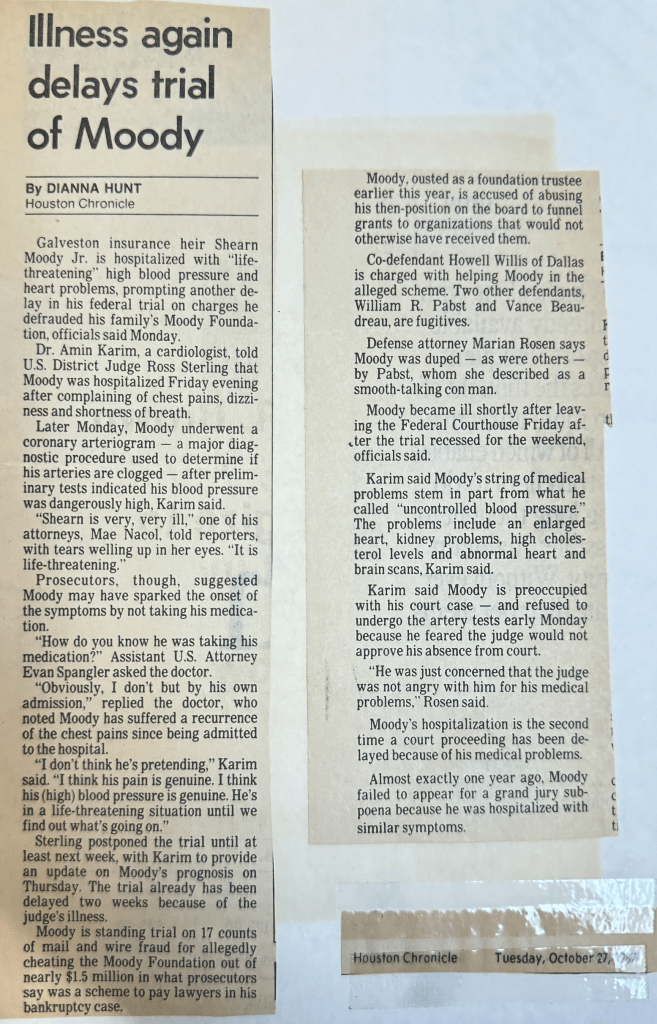
The Famous Moody Case

By Amin H. Karim MD

In 1987, I was approached by an attorney firm to take care of patient who was under trial. I did and next thing you know is a subpoena from the Court to present in the courtroom to give a deposition in front of the Judge. The proceedings are all public records. Later, the attorney (not mentioned in the article) herself became my patient.