Treating a Common disease in an Uncommon Country: Hepatitis A

By Syed Aman Ali
Medical Student, Jinnah Sindh Medical University, Karachi. Pakistan
Amin H. Karim MD
, Houston, Texas

A condition that, once diagnosed in a young person, can be treated conservatively with diet and rest, can end up being treated expensively in a milieu where defensive medicine and financial incentive join together.
The case below is an example.

Case Presentation

A 20-year-old male student presented to the clinic with a 1-week history of abdominal pain and jaundice. He described the abdominal pain as a heaviness localized to the upper right quadrant, rating it 8 out of 10 on the pain scale. The patient also experienced mild fever, vomiting, and a headache. Patient later noticed jaundice, evidenced by icteric eyes and yellowing of the skin. He also reported dark urine and pale stools. He had recently traveled from Pakistan to the United States and went on a cruise approximately 2 weeks prior to the onset of symptoms.

On physical examination, the patient appeared generally well but jaundiced. Examination of the abdomen revealed tenderness in the upper right quadrant but no guarding and an enlarged liver. Patient wasĀ  advised bed rest and symptomatic treatment till he felt better and was sent home.Ā 

Lab results were returned they showed that Hep A antibody was found to be reactive while Hep B and Hep C were non- reactive.Ā  Patient had a high total bilirubin of 12.8 mg/dl and alkaline phosphatase was raised to 182 U/L. AST was raised to 4317 U/L and ALT was raised to 5340 U/L. Patient had an increased hemoglobin 17.8g/dl and hematocrit 55.9%. The plan from our end continued to be conservative and symptomatic.
At the insistence of parents, patient saw a gastroenterologist for a second opinion and was immediately sent to the emergency room where he was admitted to the hospital for three days. A second gastroenterologist was called upon to see the patient. All of the lab reports were repeated and more tests were done including Epstein Barr virus test, cytomegalovirus test, thyroid panel. Patient had an ultrasound of the abdomen showing normal results an abdominal CAT scan showing normal result to be followed by an MRI of the abdomen which was also normal. The rationale for doing all three tests with a low pre-test probability of finding anything of significance was not known, Liver function tests were repeated on a daily basis. Liver biopsy was contemplated but not done. Family was reassured by providers that all is being done to make sure the condition does not become worse and that no “other conditions” are being missed!

In summary, the overall cost for the patient’s treatment, considering all expenses, ranged from $20,000 to $24,000. This cost reflects the comprehensive management of a benign condition easily treated with supportive care.

Discussion

Hepatitis A is an acute viral infection caused by the Hepatitis A virus (HAV), transmitted primarily through contaminated food or water. This positive-sense, single-stranded RNA virus, belonging to the Picornaviridae family, primarily affects the liver. It is a significant global health issue, especially in areas with poor sanitation. Typical symptoms include jaundice, fever, abdominal pain, and fatigue. While often self-limiting, Hepatitis A can lead to serious complications in some cases.

Complications and Variants

  1. Cholestatic Hepatitis A: Characterized by prolonged jaundice and impaired bile excretion, leading to darker urine and pale stools. Recovery is often longer and more intense.
  2. Prolonged Hepatitis A: Symptoms such as fatigue and jaundice extend beyond the usual acute phase, requiring extended care.
  3. Relapsing Hepatitis A: Involves periods of improvement followed by recurring symptoms like jaundice and abdominal pain, complicating the clinical course.

The chances of the above complications not withstanding, the condition in young people is benign and self limiting with no sequalae, in fact long term resistance to repeat infection

An important factor is to enhance the protocols for diagnosis and therapy. Better resource management and lower total costs can be achieved by establishing standardized care standards that prioritize evidence-based, economical therapies and simplify diagnostic tests to prevent redundancy. Improving the infrastructure for healthcare is also essential. By investing in sanitation and hygiene improvements in high-risk areas, as well as expanding access to early treatment and preventive care through community health centers and mobile clinics, outbreaks can be avoided and the financial strain on the healthcare system can be minimized.

Lastly, encouraging innovation and research can lead to advancements in prevention and treatment. Encouraging research into new, cost-effective management strategies and adopting best practices based on research findings will contribute to better healthcare outcomes. By implementing these strategies into practice, we can improve patient care while lowering costs in a more effective and efficient healthcare system.

Conclusion 

In conclusion, this case study reveals a significant and somewhat ironic truth: treating Hepatitis A, a condition that often resolves on its own with minimal intervention, can still come with a hefty price tag of $20,000 to $24,000 in a milieu of defensive cum financially incentivized medical care. To address this, we should focus on preventive measures like vaccination and improved sanitation, which can help reduce both the incidence of Hepatitis A and the associated treatment costs. Additionally, refining diagnostic and treatment practices, investing in better healthcare infrastructure, and encouraging innovation in care strategies can lead to more efficient use of resources and reduced costs. By making these changes, we can enhance patient care and alleviate the financial strain on the healthcare system.
A Diagnostic and Therapeutic Challenge

By Dr. Salman Arain MD

Here is a case I recently presented at CVI. I broke it up into different videos for teaching. A PDF of the complete presentation is included at the end.

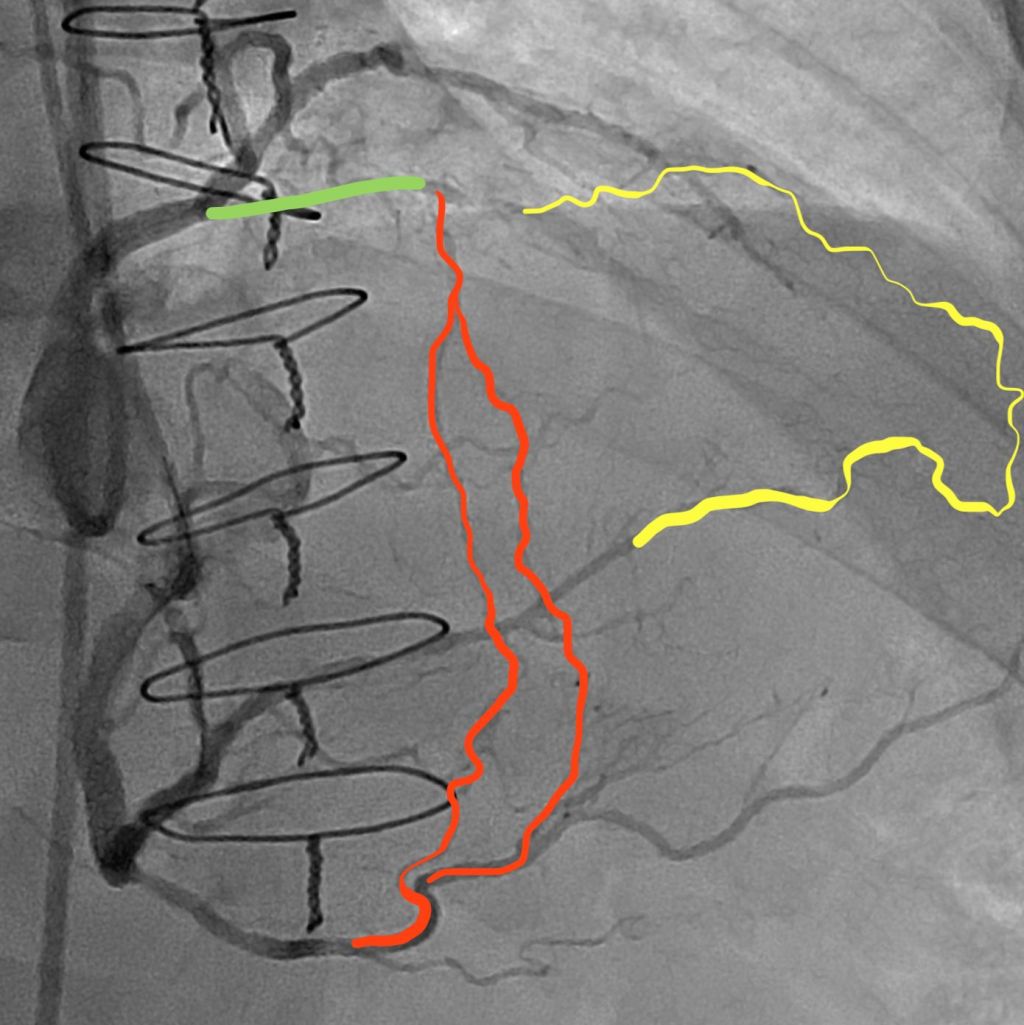
62 year old man with HTN, DM2, and CKD 3. Presents with progressive angina for three months. Now CCS class 3. The referring MD sent him for a CTA – no stress test available. How would you approach this?

There are several notable features:

  1. Anonymous left main from the non-coronary cusp.
  2. Proximal LAD occlusion with a diseased mid segment.
  3. Bifurcation disease involving the high ramus/OM1.
  4. Patent LIMA, which supplies the distal LAD.
    4b. Patent intracostal branch from the LIMA, which may be causing a steel phenomenon.
  5. Moderate disease involving the takeoff of the high PDA.
  6. Occluded SVG to the PDA (not shown).

As such, it is difficult to determine the exact location of the ischemia. There is also a second diagonal branch, which is diffusely diseased and supplied by epicardial collaterals.

I asked the referring MD to get a stress test. The patient had ischemia in the basal and mid anterior wall and anterolateral segments.
Our plan was to treat the high Ramus/OM1 and then proceed with the LAD CTO PCI. Here is the LCX PCI. We performed Culotte.

This is the dual injection angio for CTO PCI planning.

Here are some potential options for the CTO PCI.
Antegrade contrast modulation seemed to be our best bet. Here is the sequence for this rather novel crossing technique…

Proximal cap puncture with Gaia 2

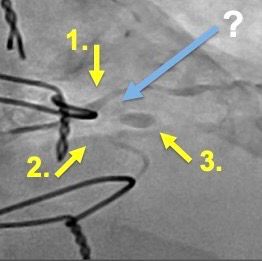
The modified Carlino injection. Note the three breakout stains. In chronological order, these are a diagonal, a septal, and the distal true lumen.

These are the three stains. Carlino has a name for this mechanism of CTO crossing. He calls it hydrodynamic contrast recanalization. Or HDR for short. This is a new term that you will be hearing about quite a bit in the future.

It can be difficult to tell if the ongoing stain is re-entry or infiltration into the extra plaque space. A retrograde injection clarifies this.

A Fielder XT without a tip bend is advanced across the channel made by the contrast under fluoroscopic guidance.

The micro catheter is an advanced over this wire. We confirm distal re-entry by means of pressure transduction and…

A distal tip injection.

Here is the final angiogram. This case highlights a new CTO crossing technique introduced by Mauro Carlino, and refined by us at UT. He calls it HDR as noted above. We have just submitted a paper describing the technique, and hopefully it will be accepted (soon!).


For our colleagues: CTO PCI is a mature field and several strategies for crossing CTOs have been developed. Most of them use wires. This ā€˜new’ technique is not so new – it is modification of an older technique which uses contrast injections. It is called Carlino after the interventionalist who described it.


Cardiac Neural Ablation (CNA)

By Dr. Kamran Aslam

Tons of great interventional content! Thought I’d add some EP:

Who doesn’t hate vasovagal syncope? Usually, younger patients with little comorbidities, lifestyle changes aren’t always effective, and pacemakers help the HR but the patients still feel poorly. Then young pts have to deal with PPM gen changes, lead issues etc.

Had been doing this in Chicago for a bit, now in Houston: Cardiac Neural Ablation (CNA)

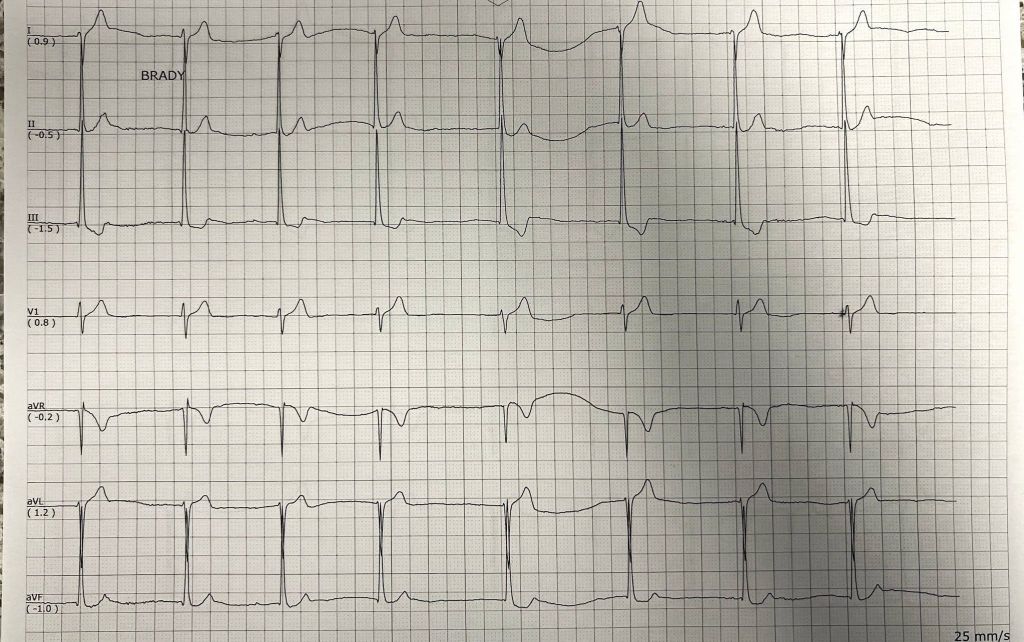
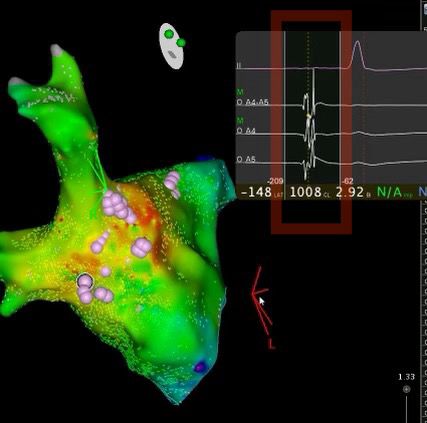
Male pt Mid 30s pt with multiple episodes of VVG syncope, no offending meds, documented drop into junctional with sx. Resting Brady. Referred for pacemaker. One of the screening tools, is giving 1mg atropine to see if there’s a ⬆ HR by at least 10 bpm. He qualified. Took him to EP study. Very detailed electroanatomic map of RA, LA, looking for high fractionated signals in usual anatomical spots posteriorly indicating presence of vagal plexus. Ablation in this area shows response of ⬆ HR during RF šŸ”„. End point: lack of atropine response. Then clinical observation for sx. Upto 4 patients in Houston now, no recurrence in syncope. None required pacemakers.

My group is part of the international research registry for such pts. Technique recently popularized by Turkish EP in Istanbul: Tolga Aksu

Pics: ECG with sx, Left Atrium with Pink dots = area of burn. The high frequency signals that signature vagal plexii are in the red box, that we hunt for…

once you have vasovagal syncope narrowed down by excluding everything else, removing offending drugs, these are good referrals for further work up

  • ⁠ it’s always nice to have outpatient monitoring correlating sudden bradycardia with symptoms
  • ⁠ a screening tool that I have, baseline, ECG, then IV 1 mg of atropine, With repeat, ECG, you want to see a change of at least 10 to 15 bpm increase in heart rate (these patients benefit most)
  • ⁠ a positive test for a cardio inhibitory syncope is also helpful for the record and to get pre-authorization
  • ⁠ there’s no age range, per se, but these patients tend to be younger, which is a reason for me to try and find a way to make them avoid hardware, specifically a pacemaker
  • ⁠ my last patient interestingly had resting bradycardia and was on fludrocortizone and compression socks, and very interestingly, almost immediately he was able to come off both measures and took his first fishing trip in five years
  • ⁠ A few times, with only a outpatient monitor, showing bradycardia and symptoms, then after mapping, the vagal plexus, with subsequent rapid bursting to stimulate the vagal response was the only way I could prove they could benefit — intra procedure testing… sometimes you just have to prove physiology intra op, just like utility of IVUS, FFR etc…

The Hyper Excited EKG

By Amin H. Karim MD
Parth Desai MD (Interventional Fellow)

CASE REPORT:
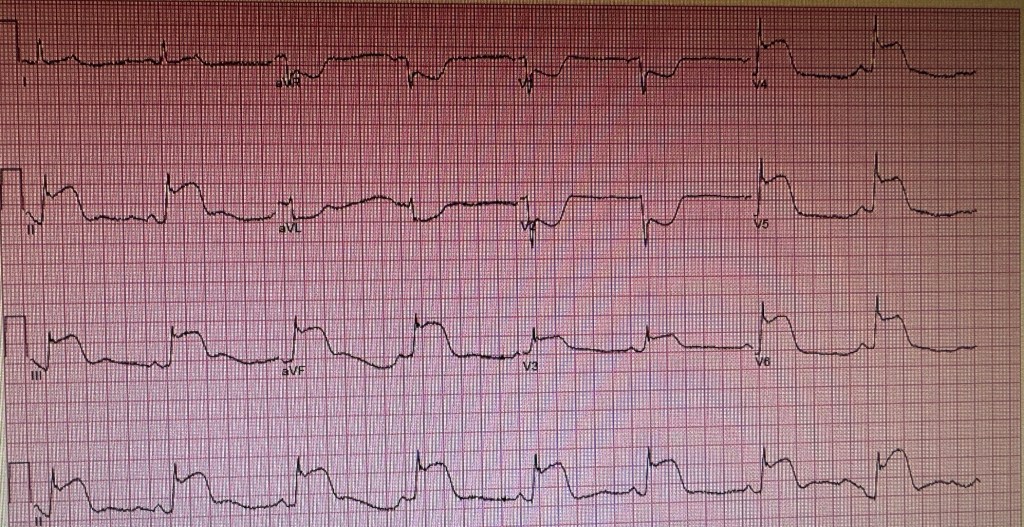
A 61 year old Caucasian female presented with sever chest pains for 3-4 hours.
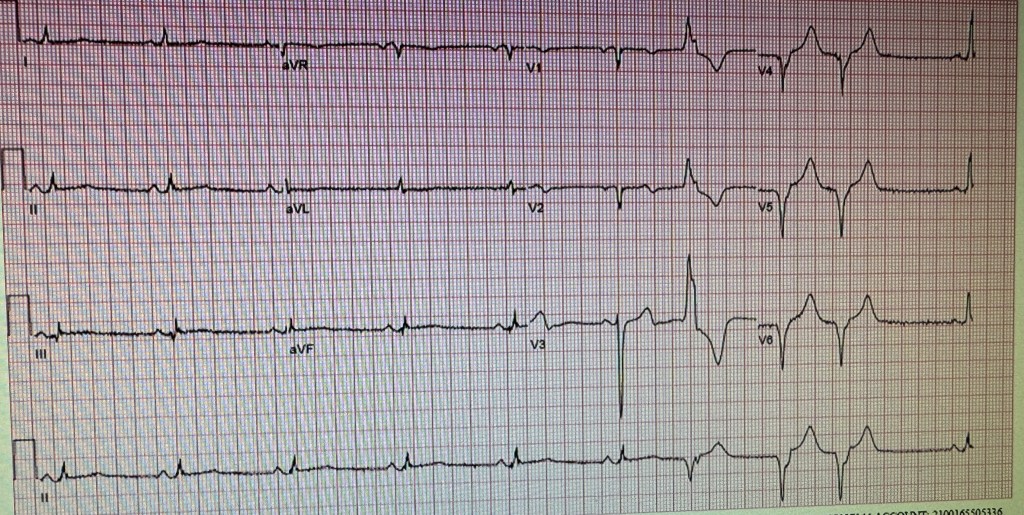
EKG was obtained.

We put it through our panel to see if they could figure out the location of the culprit lesion in this STEMI patient. The answers ranged from a large dominant circumflex or RCA to a combined lesion in the LCX and LAD.
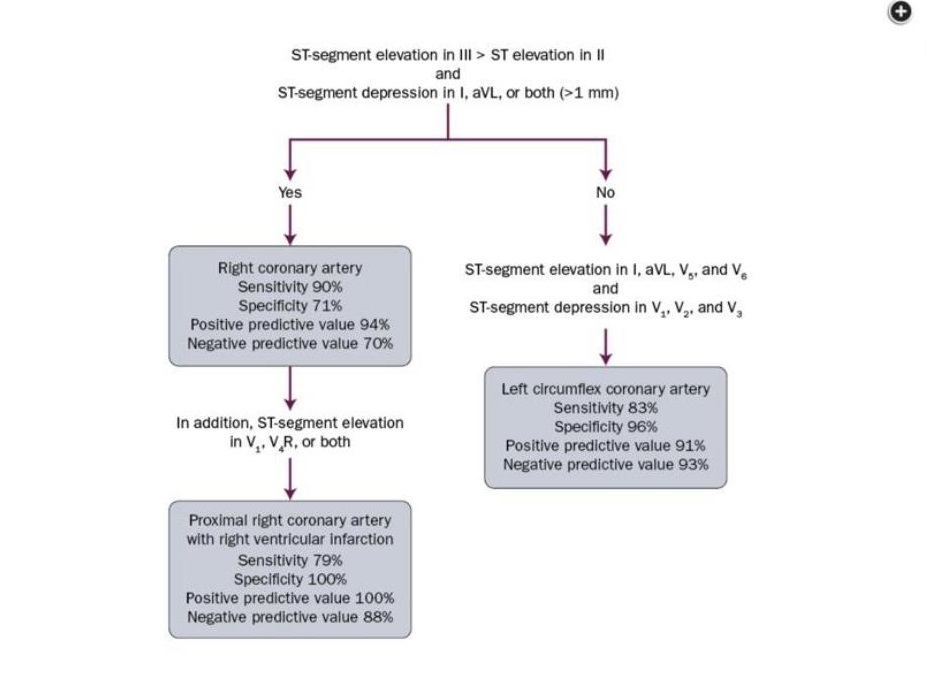
Take a moment and see if you can tell the location of the lesion. Perhaps you can use the chart that was went by Dr. Syed Fazal:


Cath showed the following:

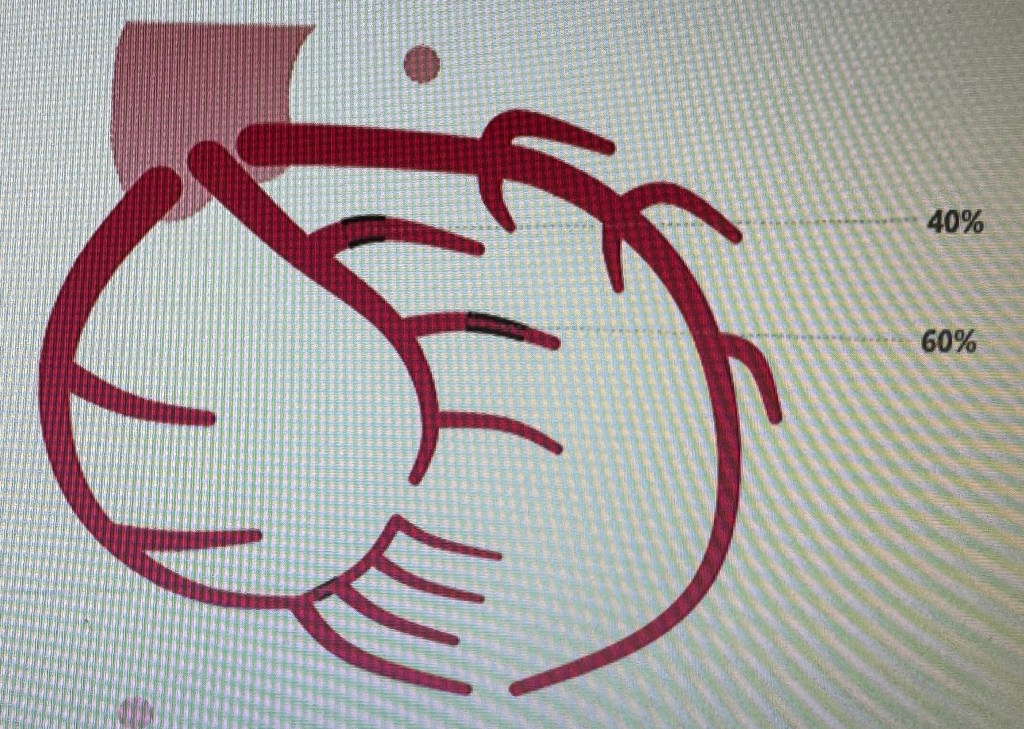
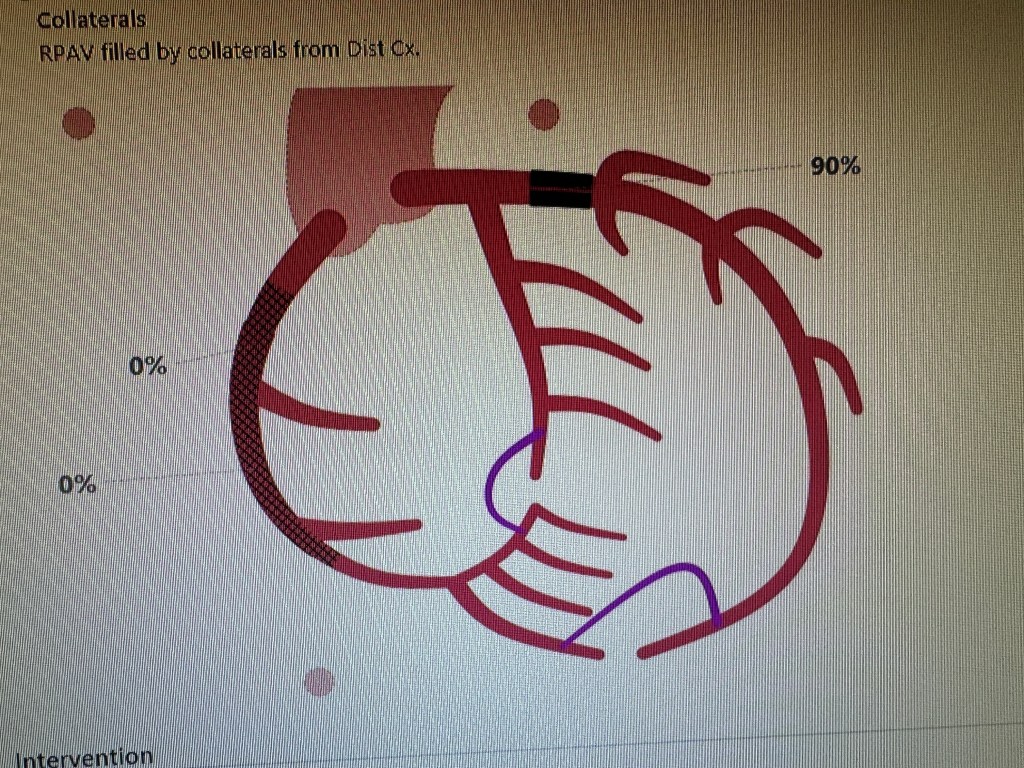
A subtotal occlusion of the left circumflex coronary artery before the obtuse marginal takeoff. It does not look that this distal circumflex supplies the anterior wall or the apex of the left ventricle.
Here is the view of the LAD (Left anterior descending) coronary artery showing there is no obvious lesion or any cut off to suggest that there may have been a clot in the artery which would have caused the anterior wall changes in the EKG.

We crossed the LCX lesion using a whisper wire, pre dilated it and placed a 3×18 mm Synergy DES with a satisfactory result.

So the question remains, why the extensive changes on the EKG when the lesion is localized and one would have expected changes in the inferior or inferior and lateral leads. Could the patient have a hypercoagulable state? malignancy?. There is no evidence of spontaneous dissection. Concomitant spasm in the LAD with the thrombus in the LCX is a possibility (reported by us in 1990’s and the two published articles are on this website). her troponins peaked at 8500. Echocardiogram showed wall motion abnormalities as follows:


EKG done the next day. Patient did well clinically. The global ejection fraction was 45-49%.
Incidentally patient also took Adderal of and on for attention deficit disorder. There are reports that these drugs can increase the incidence of cardiovascular events.
INDEBTED TO COMMENTS ON THIS CASE BY:
Prof. Salman Arain
Dr. Syed Arman Raza
Dr. Farhan Katchi
Dr. Zubair Mohammad Syed
Dr. Syed Fazal
Dr. Usman Mustafa

Anomalous Origin of the Left Circumflex Coronary Artery

by Amin H. Karim MD
Here is a case of the Left Circumflex coronary artery arising from the right sinus of Valsalva. (Type I anomaly). This happens in 0.3-0.6 percent of cases. Patient was a 42 year old lady presenting with atypical chest pain. The anomaly is usually benign but can be associated with non atherosclerotic coronary artery disease and myocardial infarction.

Left anterior descending coronary artery


Right coronary artery arising from its own ostium
The left circumflex arising from the right sinus of Valsalva separately ( Type I)

There is moderate occlusive disease in the branches of the left circumflex and the posterior descending coronary artery. It was decided to treat medically.
The anomaly brought to memory the pre-stent days of plain balloon angioplasty. We had a similar case in the 1980s presenting with unstable angina. Cath showed the anomalous origin and an ulcerated plaque in the body of the circumflex. We proceeded to do balloon angioplasty. Unfortunately, the artery dissected. We knew as trainee fellows that this was bad news. There were many measures which interventional cardiologists took to “tack up” the intimal dissection and restore the flow to the artery. Most common first attempt was to advance the same balloon back and try longer inflations as much as the patient could tolerate watching the ST Segments and the blood pressure and listening to the patient. If that did not work we tried larger balloon with low pressure inflation. In some cases it would make the dissection worse but worked sometimes. Some attendings would would try to find where the dissection started proximally and start dilating there. In any case, the procedure would go on for long. Late Dr. John Lewis would get suggest that this was all “inflammation of the artery” and would give ibuprofen to the patient. When this would not work and the artery would look more messed up he would say that “there is more trouble in the artery than in the middle of downtown Beirut” keeping in mind there was war going on in the Middle East at the time. In the meantime, the irate cardiologist who was to follow in the same room would be watching from the glass partition. And the good cardiovascular surgeons who graciously gave us “surgical backup” (mandatory in those days) would be waiting in the wings to see when we got tired to let them take the patient to the OR and operate….. šŸ™‚ Those were the days….. (Amin H. Karim November 30 2013)

The Hard to Reach Left Main

By Amin H. Karim MD

A 85 year old dialysis patient who presented with non stemi last week; we stented his occluded RCA with good result and brought him back today for his LAD lesion; looked straightforward but the access to LM proved to be a challenge being on the roof of the sinus in a dilated aging aorta. The lesion itself looked juicy and inviting! šŸ™‚ Iliac was tortuous so we ended up kinking a few catheters till we decided to beat it and go with the longest 7F sheath in the arsenal and a FR 3.5 came to our rescue. The rest was a piece of cake with predilatation and a Resolute Onyx Drug eluting stent 3.0 x 18 stent post dilated with 3.5 mm NC.
According to Dr. Waqas Qureshi, MB guide would be another option in cases of wide aortic roots.

Tight proximal left main lesion
After stent placement

The Plump RCA

By Amin H. Karim MD

A 85 year old patient on hemodialysis, presented with acute coronary syndrome. Cath showed a totally occluded RCA. This is just a straight forward case being posted initially to test the website and ease of uploading videos.

Here is the left coronary showing a tight proximal LAD but not a culprit lesion.
View of left coronary showing a tihth proximal LAD lesion but not the culprit.
Anohter left coronary view showing collaterals to the RCA.
A large occluded RCA in the proximal portion with a possible clot.
RCA double sired with a High Torque Floppy wire and a Sion Black wire.
Lesion predilated and stent with a Synergy DES 4.5 x 28 mm stent and post dilated with a 5.0 x 15 non compliant baloon at nominal pressues. TIMI 3 flow achieved. Intracoronary nitroglycerin and intracoronary nitroprusside used. Patient remained stable throughout. Stent placement in the LAD is planned in 3 days.

The RCA Challenge

The RCA Challenge
by Dr. Salman Arain

šŸ‘†šŸ¼This is the case that almost got away. 58 year old man with a failed attempt by the referring MD. He has severe ischemia in the inferolateral region. He does not have LAD or left main disease, so not an upfront CABG candidate.

Tortuous RCA
Tortuous RCA
Here is the attempted intervention. The operator is experienced but does not do CTOs. He used an OTW balloon and some workhorse wires. He stopped because he was unable to cross and the patient started complaining of angina.

But before I do, let me just lay out some initial considerations:

  1. Guide support
  2. Crossing the tortuosity (or tortuosities!)
  3. Prevention of spasm +/- accordion effect
  4. Lesion prep – given the nodular calcium appearance.

I felt that a soft tipped hydrophilic wire was essential to start. Also, up front guide extension…

We used a Luge wire and a 6 Fr GuideLiner. Turns out, that this was the easiest part of the entire procedure. 😳 more to follow šŸ‘†šŸ¼This is BAT. Balloon aided tracking. Very helpful for advancing guide extenders over long distances, when the path is relatively open.
There is a 2 mm balloon, partially extending out of the GL tip. It is inflated to 4 atm. Both balloon and GL are advanced together. This is not my attempt. But my commentary is that the operator has good support but his choice of a microcatheter (MC) could have been better. Braided MCs perform better than OTW balloons and unbraided MCs.
Also, the wire should ideally be a highly torquable wire with an appropriate tip. Most workhorse wires don’t have adequate support and/or the appropriate tip – hydrophilic tapered would be ideal.

This is our first attempt – we used multiple wires and tip shapes. Fielder XT, Sion Black, Fighter, and Gladius Mongo.You can see that I am using the Luge as a marker wire. I also have a dual lumen catheter so that the wires don’t interact (with the bonus advantage of support).

Anyway, in the interest of time and not to bore the audience with the drawn out style (which is how I teach!), we decided to take another hi-res view of the lesion. Turns out it is very complex because it comes off in a retroflexed manner, there plaque proximal to it which deflects the MC, and there is a hinge point which makes the lesion even tighter in systole!!! I have deliberately slowed it down here. So, last question. What do you do here? How to solve this twist in the tail?!

What we ended up doing (with luck as much as intention) is creating a ā€˜biplanar curve’ aka a spiral tip. It bent both downwards and to the side. This allowed us to ā€˜cork screw’ the wire (Mongo) into the PDA.

But, to put it in perspective, what looks like an obvious solution (now) took years of doing complex cases to achieve. And hundreds if not thousands of cases

Final thoughts. There are three ways to use a balloon to advance a GL.

Anchoring. Best for short distances with few bends. You can do it repeatedly as you go down the vessel.

Inch worming. This is where you deflate the balloon and advance the GL over it. Best for heavily calcified arteries and/or tracking within stents.

  1. BAT. Best for arteries with extreme tortuosity, which are otherwise patent proximately. Or to go down open grafts.

Thank you but we tried all combinations I could think of. With all types of wire tips. Even a Carlino to make a channel and a knuckle. Nothing worked – primarily because the lesion is foreshortened in our initial working view and because the ā€˜hinge’ at the PDA origin changes the orientation of the opening with every heart beat. A dynamic stenosis! BTW, the wires we used included a Fielder XT, Fighter, Mongo, Sion Black, and a Gaia 2. The bi-planar tip is on the Mongo.
And not with the usual curve added to the pre-shaped tip. Only after we gave it a sideways second curve. You can see it unfold a bit, before we were able to advance it across the stenosis.

Prof. Salman Arain

Permission to reproduce above obtained from Dr. Salman Arain on Nov 27 2023