
By Salman Arain MD
Case of the Week – A Foot In The Door May Be All You Need!
Here is a complicated RCA intervention from this week with several discussion points. There is a bonus here – my technique for changing guides over a coronary wire. There are several sequences – but not as many as there could have been!
Baseline angio. 73 year old woman with severe angina – history of bypass with failed RCA graft. Has critical ISR at the RCA ostium. The referring had difficulty stabilizing a JR4 guide and was unable to wire the stenosis.
Here the initial wiring sequence. We used an AL1 to engage the ostium as best as we could. We used a Fielder XT to wire the ISR – it is the perfect wire to do this because of the tapered tip, the polymer jacket and the supportive shaft.
But that AL1 position is not ideal for working. The next is to build up support. We used a TurnPike LP to dilate the channel and switch out for an exchange length wiggle wire. TP LP is ideal because of its double nitinol braid – it can drive itself forward even when support is suboptimal. Once the wire is in, we can dilate with a long balloon. IVUS to follow.
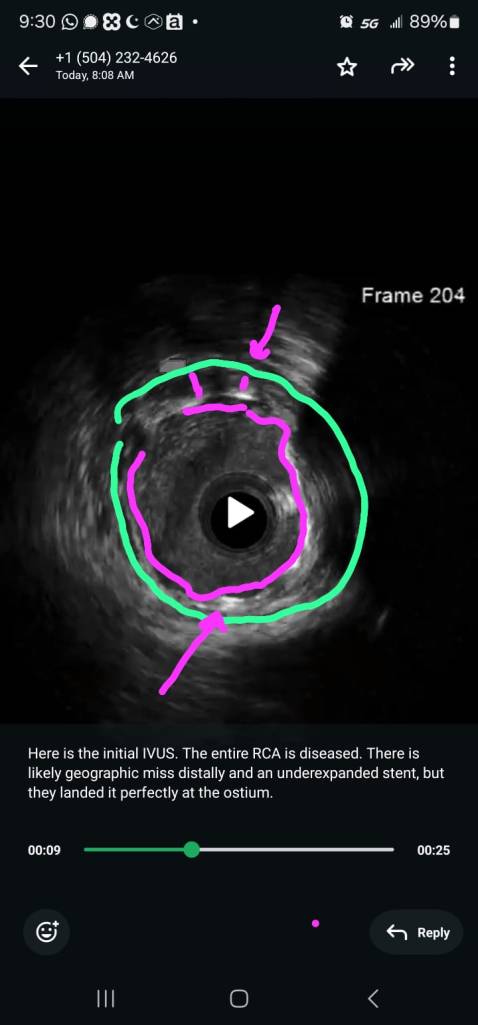
Here is the initial IVUS. The entire RCA is diseased. There is likely geographic miss distally and an underexpanded stent, but they landed it perfectly at the ostium. An AL1 is not the best guide for the remaining sequence which involves engaging and disengaging the RCA ostium. So we decided to switch guides.
Here the entire sequence to switch the guides over a coronary wire. You need a long (preferably supportive) coronary wire, and exchange length 0.035 wire, and patience!!! The 0.035 wire straightens out the AL1 during transfer.
Here is the post IVL result by IVUS. The calcium ring is disrupted is several places!
After using a 4 mm NC balloon, we implanted a 4 x 48 mm SYNERGY. Here is the post stent IVUS. We post dilated with a 4 mm NC balloon.
Here is the final result! You can see the contrast in size between the stented segment and the native, diseased RCA. There is always a risk of ‘over stretching’ the vessel when IVUS measurements are strictly followed, but this is an acceptable ’step down’.
QUESTIONS:
AA Salman bhai, I had 3 questions for my own learning, not questioning. Angiographically its a beautiful result as expected from you.
is the stent truly undersized or just underexpanded (heavy calcium) in some areas by the original operator?
any for shockwave or laser (not great for calcium ) to help expand the calcium. on your post ivus the calcium appears to prevent expansion but angiographically looks awesome. risk (calcium perf ) /reward of expanding this area with a short 4.25 NC given his prior restenosis and ostial location. i would have left it as you did,
why wiggle wire? what other wire if not wiggle wire?
Good questions.
1) Undersized versus under expanded? Difficult to say. As you know, most stents between 2.5 and 3.5 mm are the same size. The difference is in the size of the balloon that they are mounted on. (@Waqas T. Qureshi MD Bhai can confirm or refute this). So, it is difficult to say whether the stent was just undersized from the get-go or not fully expanded. But it is clear that there is geographic miss and under preparation of the vessel.
2) Absolutely. I highly recommend aggressive post dilation after any atherectomy or IVL. You have to ensure the vessel will expand before the deploying another stent.
2b) This also highlights the limitation of angiography alone to gauge vessel size in diffusely diseased arteries.
2c) Post dilation options include noncompliant balloons and (now) OPN.
3) Any supportive wire may have worked. I like to use the wiggle when dealing with torturous RCAs or LADs. The wiggle portion often locks the wire in position, adding to the support provided by the wire. Of course, any other support wire may have also worked.
 GlobeMedic