

Lipfendra and the Emerging Era of Lipoprotein(a) Management:
A Clinical Review
Authors:

Noe Rodrigo Martínez-Paredes, Medical Intern (Hospital de los Maestros SNTE Sección 50, Monterrey, Mexico).
- Amin H. Karim, MD, Baylor College of Medicine, Houston, Texas and Institute for Academic Medicine, Houston, Texas.
ABSTRACT
Elevated Lipoprotein(a) [Lp(a)] is an independent, genetically driven, and highly prevalent risk factor for atherosclerotic cardiovascular disease (ASCVD) and calcific aortic valve stenosis (CAVS). While traditional statin therapies effectively lower low-density lipoprotein cholesterol (LDL-C) via hepatic receptor upregulation, they consistently fail to reduce Lp(a) levels and may paradoxically increase them. This review highlights the critical transition toward precision cardiovascular pharmacology, focusing on Lipfendra (enlicitide)—a breakthrough oral PCSK9 inhibitor—and the revolutionary development of RNA-targeted therapies designed to definitively silence hepatic Lp(a) production.
1. THE LIPOPROTEIN(a) CHALLENGE
Lp(a) is recognized as one of the most atherogenic and pro-thrombotic lipoproteins in human plasma, yet it remains significantly underdiagnosed in standard clinical practice.
- Genetic Determinism: Unlike LDL-C, which is heavily influenced by diet, exercise, and metabolic syndrome, circulating Lp(a) levels are up to 90% genetically determined by the LPA gene locus on chromosome 6. Lifestyle modifications have virtually zero impact on its concentration.
- Unique Pathophysiology: Lp(a) consists of a standard LDL-like particle covalently bound to a highly specific glycoprotein called apolipoprotein(a) [apo(a)].
- Pro-Thrombotic Nature: The molecular structure of apo(a) is highly homologous to plasminogen. This structural mimicry allows Lp(a) to competitively inhibit plasminogen activation on the surface of fibrin clots, thereby impairing natural fibrinolysis and promoting a pro-thrombotic state.
- Vascular Inflammation and Stenosis: Lp(a) serves as the primary carrier of oxidized phospholipids (OxPL) in the bloodstream. When deposited in the arterial intima, these OxPLs recruit monocytes, driving foam cell formation. In the aortic valve, they trigger an inflammatory cascade that leads to osteogenic differentiation, making Lp(a) a primary driver of CAVS.
2. THE STATIN PARADOX AND THERAPEUTIC LIMITS
Standard HMG-CoA reductase inhibitors (statins) are the undeniable foundation of ASCVD primary and secondary prevention. However, their mechanism reveals a critical vulnerability when managing elevated Lp(a).
- Mechanism Failure: Statins lower plasma cholesterol by inhibiting hepatic cholesterol synthesis, which subsequently upregulates LDL receptors (LDLR) on the hepatocyte surface. However, because the apo(a) moiety physically shields the binding domains of the Lp(a) particle, it has a extremely weak affinity for the LDLR. Consequently, statin-induced LDLR upregulation clears LDL-C but leaves Lp(a) circulating.
- Paradoxical Elevation: Extensive clinical registry data and meta-analyses have demonstrated that statin therapy can actually increase Lp(a) serum levels by 10% to 20%. This is believed to occur due to a compensatory intracellular mechanism where the depletion of hepatic cholesterol triggers an increase in the transcription of both PCSK9 and the LPA gene.
- The Residual Risk: Patients on high-intensity statins who achieve optimal LDL-C targets but have persistent Lp(a) elevations remain at a profoundly high risk for recurrent myocardial infarctions and ischemic strokes.
3. EMERGING THERAPIES: TARGETED MECHANISMS OF ACTION
To address this residual atherothrombotic risk, novel pharmacological pathways bypass the standard HMG-CoA reductase mechanisms entirely.
A. Oral PCSK9 Inhibition (Lipfendra / Enlicitide)
- The Pharmacological Barrier: Historically, PCSK9 inhibitors required subcutaneous injections because peptides are rapidly degraded by gastrointestinal enzymes and possess poor epithelial permeability. Lipfendra utilizes a specialized macrocyclic peptide structure designed to overcome the gastric environment and achieve efficient systemic absorption.
- Mechanism of Action: Once absorbed into the portal circulation, Lipfendra binds with exceptionally high affinity to circulating PCSK9 protein. By neutralizing PCSK9, it prevents the lysosomal degradation of LDLRs, dramatically extending their lifecycle on the hepatocyte surface.
- Clinical Efficacy: It is the first once-daily oral PCSK9 inhibitor, dramatically improving patient adherence. While its primary role is achieving massive LDL-C reductions (up to 50%), it also provides a modest, yet clinically relevant, secondary reduction in Lp(a) of approximately 20% to 30%.
- Advantages Over Injectables and Traditional Therapies: While monoclonal antibodies targeting PCSK9 (evolocumab, alirocumab) offer profound LDL-C reduction, they present significant logistical and psychological barriers, including the need for subcutaneous administration, cold-chain storage, injection-site reactions, and reduced long-term adherence due to needle fatigue. Lipfendra bridges this gap by delivering “biologic-level” efficacy in a convenient oral formulation. Furthermore, it overcomes the limitations of other traditional lipid-lowering classes. Unlike statins, which can paradoxically raise Lp(a) and cause debilitating myalgias, or ezetimibe and bempedoic acid, which provide only modest LDL-C reductions (15% to 25%), Lipfendra offers aggressive LDL-C lowering paired with a targeted reduction in Lp(a) without inducing muscle toxicity.
- Safety Profile and Adverse Effects: Data from clinical trials indicate that enlicitide is highly tolerable. Because its mechanism of action is entirely extracellular and does not interfere with intracellular cholesterol synthesis like statins, it effectively eliminates the risk of statin-associated muscle symptoms (SAMS). The most commonly reported adverse effects are mild, transient, and primarily gastrointestinal—such as nausea, flatulence, or mild dyspepsia—which are often associated with the strict fasting conditions required for optimal absorption. Clinically significant hepatotoxicity or severe systemic immunogenic reactions have not been observed, making it an exceptionally favorable option for statin-intolerant patients.
B. RNA-Based Genetic Silencing (ASOs and siRNAs)
These therapies represent the ultimate precision medicine approach, targeting the LPA mRNA directly in the hepatocyte to prevent the translation of the apo(a) protein. Without apo(a), the complete Lp(a) particle cannot be assembled.
- Antisense Oligonucleotides (Pelacarsen): This ASO binds specifically to the transcribed LPA mRNA. Upon binding, it recruits RNase H1, an intracellular enzyme that degrades the target RNA strand. Administered via monthly subcutaneous injection, it achieves an ~80% reduction in circulating Lp(a).
- Small Interfering RNAs (Olpasiran / Lepodisiran): Conjugated with GalNAc to specifically target hepatocyte receptors, siRNAs utilize the natural RNA-induced silencing complex (RISC) to continuously cleave LPA mRNA. Because the RISC complex is highly catalytic, a single subcutaneous injection can provide a sustained >95% reduction in Lp(a) for 3 to 6 months.
4. COMPARISON OF ADVANCED LIPID-LOWERING MODALITIES
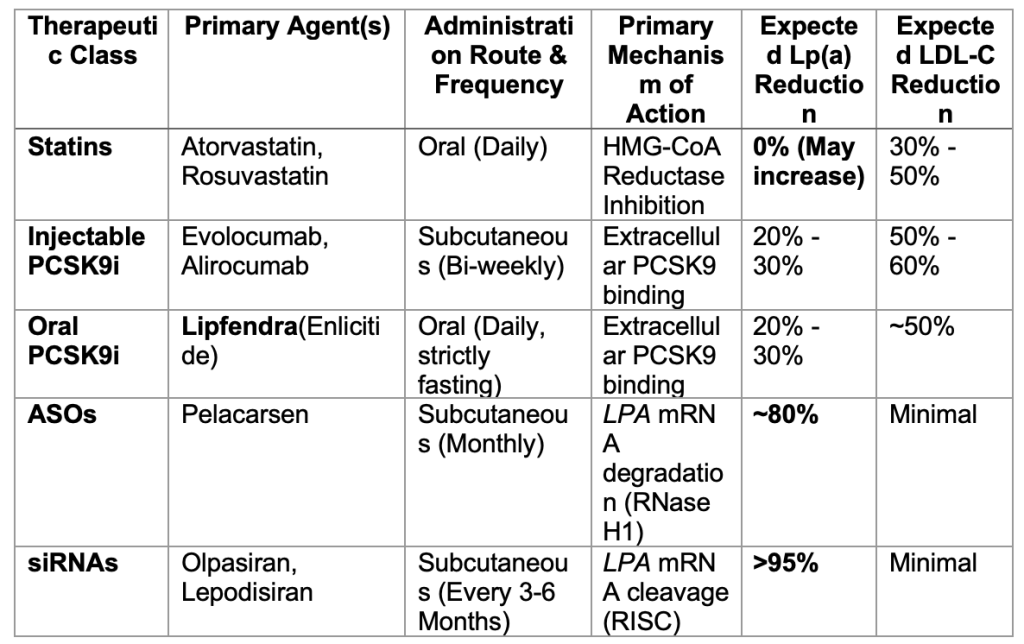
The landscape of lipid management is rapidly evolving beyond standard statin therapy. Selecting the appropriate pharmacological agent now requires a nuanced understanding of a patient’s specific lipid profile, particularly when addressing residual risks associated with isolated Lp(a) elevations versus primary LDL-C management. The following table provides a comprehensive overview of the primary mechanisms, administration routes, and expected efficacies of both established and emerging lipid-lowering therapies, highlighting the distinct advantages of oral PCSK9 inhibitors and RNA-targeted silencing.
5. CLINICAL PRACTICE & FUTURE GUIDELINES
- Universal Screening: Recognizing the hidden danger of genetic dyslipidemias, major cardiovascular societies (including the ACC/AHA and the ESC) now strongly recommend measuring Lp(a) at least once in an adult’s lifetime to identify individuals with inherited ASCVD risk.
- Dosage and Administration of Lipfendra: Based on advanced clinical trials, the optimal therapeutic dosage for enlicitide ranges from 20 mg to 30 mg taken once daily. For optimal bioavailability, this once-daily dose must be administered on a strictly empty stomach, at least 30 minutes before the first meal or beverage of the day. This strict fasting is crucial, as the gastrointestinal absorption of these oral peptides is drastically reduced in the presence of food and active gastric secretions. Routine monitoring of liver function is standard practice, although hepatotoxicity rates remain minimal.
- The Horizon of Cardiology: If ongoing Phase 3 cardiovascular outcomes trials (such as the HORIZON trial for Pelacarsen) demonstrate a definitive reduction in Major Adverse Cardiovascular Events (MACE), RNA-targeted therapies will swiftly transition to Class I guideline recommendations, establishing a new gold standard for isolated Lp(a) elevation.
6. KEY CLINICAL TAKEAWAYS
- Lp(a) is statin-resistant and genetically driven: Routine lipid panels and standard statin prescriptions are fundamentally insufficient for patients harboring genetic Lp(a) elevations.
- Lipfendra changes patient compliance: As a breakthrough oral PCSK9 inhibitor, it offers powerful LDLR upregulation without the psychological and physical burden of long-term injectable therapies.
- RNA therapies are the definitive solution: By intercepting and silencing the LPA gene directly in the liver, ASOs and siRNAs can nearly eradicate circulating Lp(a), promising to close the gap on residual cardiovascular risk.
REFERENCES
- Reyes-Soffer G, Ginsberg HN, Berglund L, et al. Lipoprotein(a): A Genetically Determined, Causal, and Prevalent Risk Factor for Atherosclerotic Cardiovascular Disease: A Scientific Statement From the American Heart Association. Arterioscler Thromb Vasc Biol. 2022;42(1):e48-e60.
- Tsimikas S. A Test in Context: Lipoprotein(a): Diagnosis, Prognosis, Controversies, and Emerging Therapies. J Am Coll Cardiol. 2017;69(6):692-711.
- Kronenberg F, Mora S, Stroes ESG, et al. Lipoprotein(a) in atherosclerotic cardiovascular disease and aortic stenosis: a European Atherosclerosis Society consensus statement. Eur Heart J. 2022;43(39):3925-3946.
- Zheng KH, Tsimikas S, Pawade T, et al. Lipoprotein(a) and Oxidized Phospholipids Promote Valve Calcification in Patients With Aortic Stenosis. J Am Coll Cardiol. 2019;73(17):2150-2162.
- Tsimikas S, Gordts PLSM, Nora C, Yeang C, Witztum JL. Statin therapy increases lipoprotein(a) levels. Eur Heart J. 2020;41(24):2275-2284.
- Willeit P, Ridker PM, Nestel PJ, et al. Baseline and on-statin treatment lipoprotein(a) levels for prediction of cardiovascular events: individual patient-data meta-analysis of statin outcome trials. Lancet. 2018;392(10155):1311-1320.
- Nissen SE, Wolski K, Prcela L, et al. Efficacy and Safety of an Oral PCSK9 Inhibitor in Statin-Treated Patients: A Phase 2 Randomized Clinical Trial. JAMA Cardiol. 2023;8(5):455-462.
- Ballantyne CM, Banka P, Mendez G, et al. Phase 2b Randomized Trial of the Oral PCSK9 Inhibitor MK-0616. J Am Coll Cardiol. 2023;81(16):1553-1564.
- Nurmohamed NS, Dullaart RPF, Stroes ESG. Oral PCSK9 inhibitors: A new era of accessible lipid-lowering therapy? Curr Opin Lipidol. 2024;35(1):15-21.
- O’Donoghue ML, Rosenson RS, Gencer B, et al. Small Interfering RNA to Reduce Lipoprotein(a) in Cardiovascular Disease (Olpasiran). N Engl J Med. 2022;387(20):1855-1864.
- Tsimikas S, Karwatowska-Prokopczuk E, Gouni-Berthold I, et al. Lipoprotein(a) Reduction in Persons with Cardiovascular Disease (Pelacarsen). N Engl J Med. 2020;382(3):244-255.
- Nissen SE, Wolski K, Balog C, et al. Single Ascending Dose Study of a Short Interfering RNA Targeting Lipoprotein(a) Production in Individuals With Elevated Plasma Lipoprotein(a) Levels (Lepodisiran). JAMA. 2023;330(21):2075-2083.
- Katzmann JL, Laufs U. Pharmacological lowering of Lipoprotein(a). Curr Opin Lipidol. 2023;34(3):133-140.
- Grundy SM, Stone NJ, Bailey AL, et al. 2018 AHA/ACC/AACVPR/AAPA/ABC/ACPM/ADA/AGS/APhA/ASPC/NLA/PCNA Guideline on the Management of Blood Cholesterol. Circulation. 2019;139(25):e1082-e1143.
- Mach F, Baigent C, Catapano AL, et al. 2019 ESC/EAS Guidelines for the management of dyslipidaemias: lipid modification to reduce cardiovascular risk. Eur Heart J. 2020;41(1):111-188.

